A series of incidents
|
 |
|
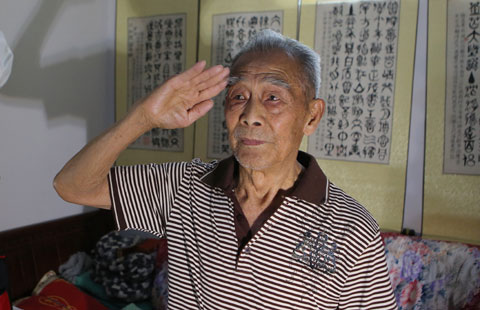
This 2001 photo shows Song Xuewen, who found a key chain-shaped source of ir-192 at a construction company in Jilin province in 1996, and later suffered from radiation sickness. Provided to China Daily |
In January 1996, 21-year-old Song Xuewen found a key-chain-shaped source of ir-192 at a construction company in Jilin province. He kept it in his pocket for 10 hours and later suffered radiation sickness. He underwent seven operations in the following two years, in which both of his legs and an arm were amputated.
In April 2005, when two policemen in Liaoyang, Liao-ning province, detained a man suspected of stabbing his girlfriend, they discovered an unusual metal chain, which they took to the police station and placed in a cupboard. A few days later, three officers who worked in the office began to lose their hair, vomited frequently and discovered large amounts of blood in their feces. All three men, in their early 30s, were later diagnosed with radiation sickness and found to be infertile.
The assailant, who later died of radiation sickness, admitted he had "borrowed" the chain, which contained ir-192, from an inspection company with the help of friends, and had planned to injure his girlfriend by exposing her to radioactivity.
In June 2005, 117 people in a residential community in Harbin, Heilongjiang province, were exposed to ir-192 after a source was thrown into a garbage disposal unit. Six people were diagnosed with health problems and one person died. The radioactive material bore no code - in contravention of the law - and wasn't registered with the monitoring authorities.
In October 2009, residents of Panyu in Guangdong province panicked after news broke that an irradiator at a local technical research center had been emitting radiation continuously for 48 days because of an operational error.
In 2004, China's leading environmental protection authorities, health authorities and public security departments conducted a survey that revealed that more than 10,000 agencies across the country possessed more than 140,000 sources of radioactivity.
The survey estimated that the number of sources was growing at 5 to 10 percent annually, and that more than 2,000 sources had gone missing.
According to the Case Compilation of China's Radiological Accidents 1988-1998, a report compiled in 2001 by the ministries of health and public security, the period had seen 332 accidents involving 966 people. The report said 584 sources of radioactivity had been reported as lost, and that 256 of them were still missing.
"Most radioactivity-related accidents happened in the last century or at the very beginning of this one," said Pan Ziqiang, an expert on nuclear radiation prevention and control at the Chinese Academy of Engineering.
"No one has died in an accident of this nature since 2005, when new radiation safety and prevention regulations came into effect that required departments involved in accidents related to radioactivity to assume legal, administrative and economic responsibility. Supervision has been strengthened, but it's hard to completely avoid accidents involving radioactive sources," he said.
According to Pan, 10 people have died from radiation poisoning emitted by radioactive sources and in industries in which nuclear techniques are used, accounting for 17.2 percent of the global total. No one has died or contracted radiation sickness in the nuclear military industry or nuclear power plants.


Copyright 1995 - . All rights reserved. The content (including but not limited to text, photo, multimedia information, etc) published in this site belongs to China Daily Information Co (CDIC). Without written authorization from CDIC, such content shall not be republished or used in any form. Note: Browsers with 1024*768 or higher resolution are suggested for this site.
License for publishing multimedia online 0108263 Registration Number: 130349