 |
|
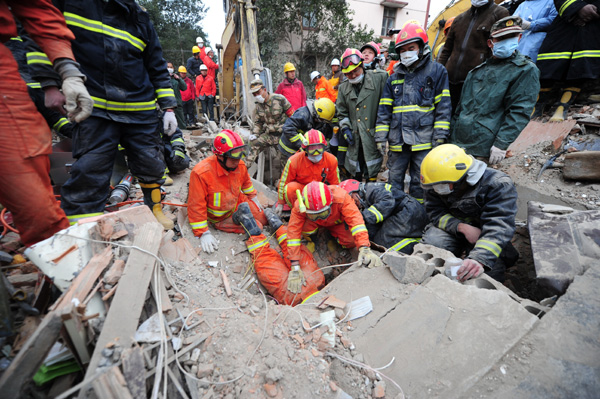
This 2012 photo shows rescue teams work to save residents of a collapsed six-story building in Ningbo, Zhejiang province. Yan Jie / For China Daily |
|
Who foots the bill? The collapse of the five-story building in Fenghua, Zhejiang province, attracted nationwide attention to the problem of dangerous buildings. Now, the big question is: Who should pay for their repair and reconstruction? Ju Chunhua, an expert of the Zhejiang Academy of Social Sciences, said tracing those responsible among the architects, construction companies and developers is an impossible task 20 or 30 years after construction. "The 1990s was the peak time when companies changed status from State-owned to privately run. Also, many companies have disappeared because of bankruptcy or other reasons," he said, adding that the situation puts the onus on local governments to pay for demolition or refurbishment work and provide compensation in the wake of accidents. Each of the 40 families affected by the Fenghua accident will receive a lump sum of 3,000 yuan ($482), and each family member will receive a further 8,000 yuan. Because the building has been demolished and the reconstruction work will take time, the families will also receive a monthly subsidy of 20 yuan per square meter of their apartment's floor space for a year. Three people deemed liable for the poor upkeep of the apartment block are currently in police custody, but the local government is footing the bill for compensation. In 2012, a 23-year-old building collapsed in Ningbo, Zhejiang, claiming two lives. The city government paid each family 17,000 yuan to 18,000 yuan per sq m of their apartment's floor space. In Haining, a county-level city in Zhejiang, 1,500 students at Haining Experimental Elementary School studied in buildings that were officially designated in January 2012 as "C-level dangerous" - that is, in need of immediate reinforcement - until April 4. They were moved in the wake of the Fenghua collapse. Yu Xinhu, director of the infrastructure construction department at the Haining Education Bureau, said a lack of funding was the main problem, but now the buildings will be demolished and rebuilt at a cost of almost 55 million yuan. - Yan Yiqi |
At the time, it was common practice to cut corners, according to Feng. "To lower the costs, some developers used inferior materials. For example, they used mud instead of standard adhesives such as mortar," he said.
However, the problems that would result from these practices were not immediately apparent, and often decades passed before they became noticeable.
"The problems appeared one by one after 20 to 30 years, and by that time many of the developers had either gone out of business or had changed their company names and identities," Yang said.
Determining responsibility for the monitoring and repair of potentially dangerous buildings is the biggest problem facing the authorities, he said, "but definitely, the residents should not have to pay for it."
Wang Damao lived for 20 years in the building that collapsed in Fenghua. He bought his 90-sq-m apartment in 1994 for 70,000 yuan ($11,250), a huge sum at the time.
According to Wang, the residents began to notice structural problems several years ago when minor cracks and leaks appeared. However, he and his neighbors were unable to discover who was responsible for the maintenance of the building.
During last year's typhoon season, the problems became more serious: Parts of the exterior walls fell away, leaving the concrete reinforcement bars plainly visible.
"Sometimes we were unable to open the doors because the entire building was sinking. During the worst periods we had to sleep with the doors open," he said.
The residents approached Jinping Subdistrict, which manages the building, and the problems were reported to high-level officials, who conducted tests. After persistent requests by the residents, in January, the building was classified as "C-level dangerous", a designation that means a building requires immediate reinforcement, according to the Ministry of Housing and Urban-Rural Development.
In February, a refurbishment plan was put forward, but disputes about who should foot the 4.5 million yuan bill led to its suspension. At least, until April 4.
Wang's wife was one of the people injured in the collapse, and he believes that a faster response to the residents' requests would have saved her from injury.
"Two weeks before the accident, we twice visited the municipal bureau of letters and calls to report our housing problems. We asked for a solution, but didn't receive one," said Wang.
Shen Linxiang, secretary-general of the Hangzhou Engineering and Construction Committee, said developers and construction companies are usually responsible for the quality and subsequent maintenance of the buildings they erect.
"However, just as in the Fenghua case, after 20 to 30 years many developers and construction companies simply no longer exist. Moreover, there is no governmental funding to support these programs," he said.
Shen said because the buildings constructed in the 1980s and early 90s were among the earliest commercial residential housing built in China, there is no property management service. That means there are no funds available to support necessary refurbishment programs.
"A thorough government mechanism to ensure the safety of residential buildings should be established, to conduct regular safety checks and quality evaluations, and also to determine who is responsible for the upkeep and distribution of funding," he said.


Copyright 1995 - . All rights reserved. The content (including but not limited to text, photo, multimedia information, etc) published in this site belongs to China Daily Information Co (CDIC). Without written authorization from CDIC, such content shall not be republished or used in any form. Note: Browsers with 1024*768 or higher resolution are suggested for this site.
License for publishing multimedia online 0108263 Registration Number: 130349