|
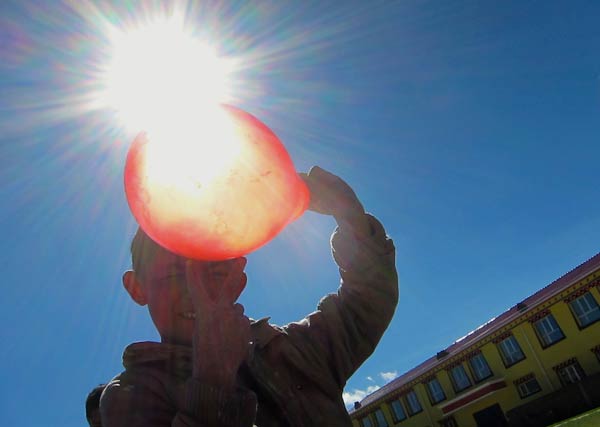 |
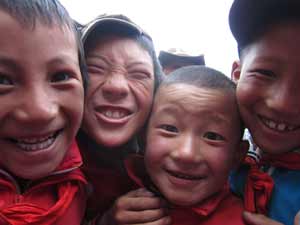
| A boy plays with a balloon in the grounds of Yege primary school in the remote nomadic community of Yushu prefecture in Qinghai province. PHOTOS BY ERIK NILSSON / CHINA DAILY |
Long ago, the nomads of Yege township in Qinghai province were noted for drinking and cutting each other with swords. But the aim was not to maim or kill. The reason was honor - the illiterate nomads settled their disputes with swords, not words.
Although the townspeople still regularly carry blades, the practice has been discontinued and the pen - or more accurately, the keyboard - is now mightier than the sword, according to Resang, the head of the township.
"The people fought because they lacked education," said Resang, who in common with many members of the Tibetan ethnic group only has one name.
"Things have gotten much quieter as more kids enter school. They educate their parents. The more the students learn in school, the more everyone does the right thing," he added.
Having said that, when I found myself in a dispute over a 10-yuan ($1.60) fare with a cab driver in Yushu, the relatively developed prefectural seat, a few days later, one glance at the blade he carried was enough to convince me to pay up without further argument. In fact, just to play it safe, I gave him 20 yuan.
That was the day after a Yege resident had shown me his sword, which he swore he had never used.
|
 |
However, beyond the blades, Yege's transformation has been truly cutting-edge.
When I first visited the area in 2011, the 76 students at the primary school slept on boards in the seven tents that served as dorms, but when I made a return visit in July last year I discovered that a new brick dorm had been built to house the student population of 65, who sleep six to a room.
That wasn't the only development: The township now boasts a new classroom - the old one was damaged in a magnitude-7 earthquake in 2010 - a clinic, a meeting and performance hall, a latrine, and a monastery, all in close proximity to modern housing.
The transformation is the result of increased investment by the local government and aid provided by StepUp.
I first came to Yege with StepUp to help bring electricity to the kids' tents. Only 5 percent of local households had power at the time. The township is too remote to be connected to the main grid, so all the electricity is generated by solar panels.
In 2011, StepUp installed two solar panels, which provided enough electricity to power the entire school.
Now, every permanent dwelling in Yege has electricity and government-provided TV sets that offer a wide range of channels.
"Some wealthy people even have fridges and washing machines," township head Resang said.
Yege's changes - both physical and psychological - have mostly emanated from the school. The nomads, who previously believed their children were better off guiding yaks than studying, have made the campus the heart of the 150-house settlement.
"Now, the herders come to the school to ask about their kids' performance," said Tseringben, a teacher.
The government has built free housing around the campus, and also in Qumalai, the county seat, 97 kilometers from Yege.
Now, 90 to 95 percent of Yege's kids attend school. "Some families still think studying isn't an option because herding feeds the household," said Tseringjia, another teacher.
A simple question
The rise in student numbers came about after a visit made by educators in 2008: they traveled across the vast grassland and visited every tent they could see. They convinced the parents of the value of education by holding up 100-yuan bills and bottles of iced tea. When the illiterate parents admitted they couldn't identify the contents of the bottles or read the denominations of the banknotes, the educators asked a simple question: "Do you want your children to be able to?" That changed everything.
"I'm nomadic but, after talking to the teachers, I realized that education is important," said a local resident called Ahzhub.
"We tell our son: 'We work hard, herd and eat food from the high mountains every day, rain or snow. We do it so you can be educated. You know how hard our lives are. You should study hard'," said the 54-year-old, adding that he's pleased by the "huge changes". "We'd heard of many things like computers and the English language, but we hadn't seen them. Now, these things have come."
Ahzhub recalled that when his 13-year-old son, Chenlee Shira, sang the alphabet in English at a school performance, a nearby family offered a yak to help with "the financial burden".
"The pronunciation of A, B, C, D sounds like 'My father has a bad leg' in our dialect. When the people heard Chenlee Shira sing the English alphabet, they thought it was a plea for charity in Tibetan," said Ahzhub.
"He learned about computers quickly. He can download and store images," said the proud father, who, although delighted with his son's technological prowess, admitted that he doesn't know what the words "download" or "store images" mean.
Ahzhub and his wife spend the warmer months in a tent in the mountains across from the school. Although there is no road, the family camps close enough for the boy to return at the weekends.
Two-story brick houses are also taking shape beside the campus. Just a few years ago, most of the dwellings in Yege were crumbling adobe hovels, but now some of the mud structures near the school are being cleared to make room for the settlement's first kindergarten, which is expected to open in September.
Yege's population is more than 90 percent nomadic, the only exceptions being a handful of teachers and officials. The herders roam with tents most of the year but hunker down in permanent lodgings during the fierce winter months. Because the altitude averages 4,300 meters, the area is covered by snow 10 months of the year and in winter the temperature plummets to -25 C.


Copyright 1995 - . All rights reserved. The content (including but not limited to text, photo, multimedia information, etc) published in this site belongs to China Daily Information Co (CDIC). Without written authorization from CDIC, such content shall not be republished or used in any form. Note: Browsers with 1024*768 or higher resolution are suggested for this site.
License for publishing multimedia online 0108263 Registration Number: 130349