Support industry
The lack of money isn't the only problem, according to Meng Yuanzhao, an archaeologist at the National Museum.
"Even if we had sufficient funds, maritime archaeology is systematic work. We still need to conduct more work to build the support industry, including the related training, education and infrastructure," he said.
 |
|
Members of the salvage team wear bamboo hats as protection from the tropical sun. Wang Ji / for China Daily |
"In the US, the divers sail out with heritage experts who are able to recognize and preserve the submerged relics. The team also includes medical-support personnel and equipment in case of accident or illness, such as decompression sickness," said Meng. "Compared with their peers in the West, where underwater archaeology originated, China's researchers are still working in a humble environment."
In 2007, Meng was present at a salvage site in the South China Sea where more than 40 field researchers spent 56 days digging up relics from a sunken cargo vessel. Experts hope that items recovered may shed more light on 12th-century China.
Far removed from the riotous swagger of Indiana Jones, the members of the team lived on dilapidated fishing boats and wore bamboo hats, the typical headgear of the local fishermen, to avoid the burning tropical sunshine.
Mandarin ducks
Maritime archaeology is a slow and dirty business, followed by an even slower process of recording the recovered items. The divers worked on their hands and knees in 20 meters of water, sifting through the ruins of what some archaeologists regard as one of the best-preserved Song Dynasty (960-1279) wrecks.
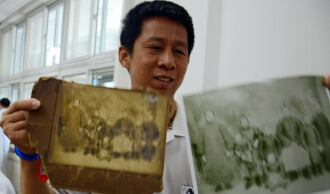
Meng displayed a photo of one of the thousands of porcelain shards found in the wreck. Two mandarin ducks, symbols of love and peace in Chinese tradition, were vividly drawn on the surface. Untouched for nearly a millennium, the shard, which is probably part of a bowl or plate, looked like a piece of jade.
It's easy to imagine a scene from 800 years ago: A small wooden merchant vessel is plying the South China Sea, laden with tea and porcelain for European consumers. A storm whips in from the east and the boat struggles, its simple sail proving more of a hindrance than a help. Unable to navigate the narrow shipping lane, the boat is dashed against the jagged rocks that rise from the blue-green water. Its fragile hull cracks, sending the valuable cargo to the sea floor to remain undisturbed for centuries
The scene shifts to the present. While China's cultural heritage on land has increasingly benefited from national and international measures to safeguard precious items, the country's underwater cultural heritage still lacks sufficient protection, according to Wu Chunming, a professor of maritime history at Xiamen University in Fujian province.
China has conducted three archaeological surveys of its land-based heritage, but only one of underwater relics. Although the survey took two years, it didn't cover all the maritime areas.
In addition to rectifying the shortages of personnel and funding, Wu urged the stronger implementation of existing laws on the protection of the underwater heritage.
"China has laws relating to the protection of our underwater heritage, but treasure hunting and the illegal sale of cultural relics are still serious problems," he said. "We have a long way to go to build a systematic approach to the protection of our underwater heritage."
Wu said China has a rich history of overseas trade and a remarkable history of navigation, and maritime archaeology has made considerable headway in recent years.
The country's underwater cultural heritage has yielded pottery, tools and other relics that have provided scholars with information about ship construction, navigational skills and the trading habits of earlier periods, he said.
Furthermore the lack of oxygen - which facilitates the deterioration of biological material - underwater means that the submerged cultural heritage is often much better preserved than at similar sites on land. That makes the submerged sites unique. They are time capsules.
"For our future development and success, China needs to shift from the land to the oceans. And to explore the seas, an understanding of maritime history is a crucial prerequisite," Wu said.
Contact the author at pengyining@chinadaily.com.cn
|
|
|
|
|
|
|
|

Copyright 1995 - . All rights reserved. The content (including but not limited to text, photo, multimedia information, etc) published in this site belongs to China Daily Information Co (CDIC). Without written authorization from CDIC, such content shall not be republished or used in any form. Note: Browsers with 1024*768 or higher resolution are suggested for this site.
License for publishing multimedia online 0108263 Registration Number: 20100000002731 



















 Op Rana
 Berlin Fang
 Zhu Yuan
 Huang Xiangyang
 Chen Weihua
 Liu Shinan