 |
|
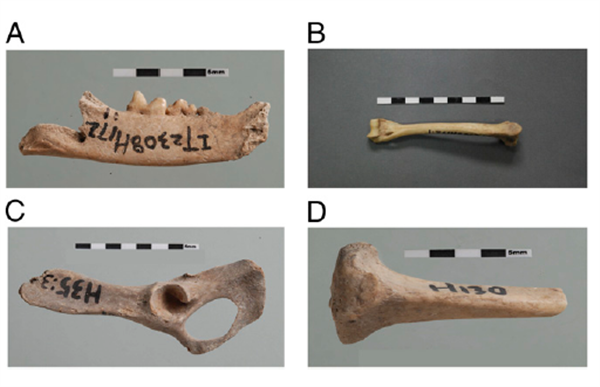
Field specimens from the site of Quanhucun showing key body parts and the presence of an aged animal with worn dentition. a. left mandible with worn fourth premolar and first molar. b. right humerus. c. left pelvis. d. proximal left tibia. |
The discovery of ancient bones in a village in Shaanxi province may challenge widely accepted theories about the earliest relationships between felines and humans, as Zhang Lei reports.
For many cat lovers, the best thing about felines is their unpredictability; sometimes they act as though they worship their "owners", but often they behave as though they have been carved from an iceberg, implacable and devoid of compassion. That unpredictability raises the question of why humans tolerated such capricious behavior in the first place.
Archeological evidence strongly suggests that the ancient Egyptians worshipped cats at least 4,000 years ago, elevating them to the status of gods and keeping them as life companions. Paintings in pyramids seem to support a general belief that the ancient Egyptians were the first humans to domesticate cats, setting an example to the rest of the world, which gradually caught up.
However, that view is now being challenged after the discovery of cat bones dating back 5,300 years in the village of Quanhucun in Shaanxi province.
The discovery was unexpected, according to Hu Yaowu, a professor at the Institute of Vertebrate Paleontology and Paleoanthropology. "The cat bones were unearthed in 2007, along with other animal bones, and locked up in the inventory room. It was not until last year that we started researching the history of ancient farming and accidentally came across eight pieces of cat bone from three different ash pits," he said.
The bones of all animals have a fixed amount of a radioactive isotope called carbon-14, which decays at a specific, stable rate after death, thus allowing scientists to determine their approximate age.
In addition to carbon-14 dating, Hu's team also tested the bones to identify the animals' food consumption structure by analyzing the amount of carbon-13 and nitrogen-5 present. A high level of carbon-13 suggests a large intake of grain-based foods, while high levels of nitrogen-5 equate to meat-based foods.
Cats are fundamentally predators, almost solely dependent on the ingestion of proteins. One of the eight specimens of cat bone was older than the others and the high levels of carbon-13 found in the specimen suggested that cat must have eaten very little meat but a substantial amount of grain-based food, leading scientists to believe it ate leftovers or was fed regularly by humans.
 |
|
Ma Xuejing/China Daily |
"The findings do not necessarily prove that the Chinese domesticated cats 5,300 years ago, because a wild cat living near a human settlement may have been fed. Maybe the cat in Quanhucun was undergoing the process of domestication, but at least it's the earliest evidence to demonstrate a commensal (symbiotic) relationship between humans and cats in China," Hu said.
Cats are among the most-loved domestic pets nowadays, second only to dogs, but little is known about how they became domesticated. Prior to the discovery, scientists worked on the theory of a "commensal pathway to domestication", a method entirely different from that used for dogs, where our human ancestors deliberately domesticated certain species of wolves, which adopted many of the characteristics present in dogs, for their hunting needs 10,000 years ago.
"Our theory is that rodents invaded agricultural villages in search of grain-based foods, suggesting the humans had cultivated a certain level of agricultural civilization. Cats also came to the area to prey on the rodents. While the farmers hated the rodents, they welcomed the coming of the predators, and provided food as encouragement. These findings provide evidence for a commensal process of cat domestication," Hu said.
The skeletons of Asiatic cat species, such as the Central Asian wildcat and the Chinese desert cat, are rarely seen in collections, and there are few details of the sizes and measurements of ancient cats. Therefore, Hu Yaowu and Hu Songmei, a professor at the Shaanxi Provincial Institute of Archeology, compared the size of the animals in Quanhucun with published data about modern European wildcats. The Quanhucun cats were larger than domesticated European cats, but smaller than, and outside the range of, European wildcats.
"The key to establishing if the cats were domestic or wild is whether they were fed regularly by humans. We have to obtain additional information on the range of size variation in Asian wildcats and DNA evidence to secure identification," Hu said.


Copyright 1995 - . All rights reserved. The content (including but not limited to text, photo, multimedia information, etc) published in this site belongs to China Daily Information Co (CDIC). Without written authorization from CDIC, such content shall not be republished or used in any form. Note: Browsers with 1024*768 or higher resolution are suggested for this site.
License for publishing multimedia online 0108263 Registration Number: 20100000002731 






 Op Rana
 Berlin Fang
 Zhu Yuan
 Huang Xiangyang
 Chen Weihua
 Liu Shinan