


Time to get straight to the point


Government spokespeople aim to improve transparency of information, Tang Yue and Cao Yin report in Beijing.
 |
|
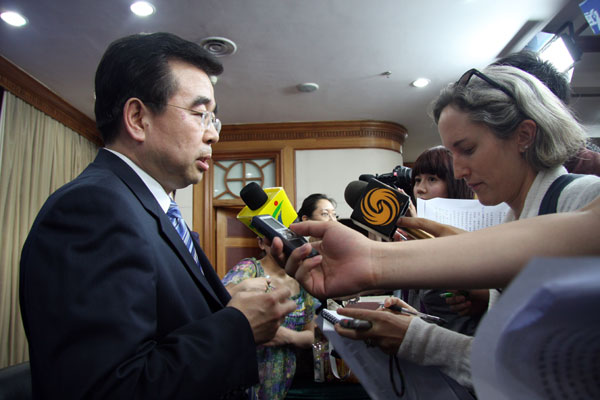
This 2009 photo shows Mao Qun'an, then spokesman for the Ministry of Health, taking questions after a news briefing. [Provided to China Daily] |
 |
|
From left to right: Geng Yansheng, Defense Ministry spokesman; Yao Jian, Ministry of Commerce spokesman; Wang Yongping, Ministry of Railways spokesman in 2011; Hua Chunying, Ministry of Foreign Affairs spokeswoman; Wang Xuming, former spokesman for the Ministry of Education. |
|
Timeline 1982 The first media briefing to feature a specific spokesperson in China is held by the Ministry of Foreign Affairs. Qian Qichen, director of the ministry's information department, utters just three sentences, commenting on China's bilateral relationship with the USSR. The briefing is attended by more than 70 reporters, both Chinese and from overseas, but no questions are allowed. 1983 The Ministry of Foreign Affairs officially starts the spokesperson system. On April 23, a small number of spokespeople from other ministries are also introduced to the media. 1989 The State Council issues a statement insisting that the Chinese State media be briefed on domestic air crashes, marine disasters and rail and road accidents ahead of foreign media. 1993 The information office of the State Council begins holding media briefings and invites spokespeople from different ministries to attend. 2003 The first training camp for spokespeople from central and provincial governments is held in Beijing. During the following decade, the program is expanded to include more local spokespeople. 2008 The Open Government Information Regulation comes into effect. 2013 The State Council announces that its information office will organize regular media briefings to address public concerns over important policies and hot issues. Heads of the central government departments overseeing macroeconomic development and people's livelihoods are required to attend the office's media briefings at least once a year, while departmental spokespeople must attend briefings once every quarter. |
The Chinese government has moved to improve the transparency of official information through a radical overhaul of the system whereby departmental spokespeople explain government policy.
The move follows an announcement by the State Council on Tuesday urging officials to adapt to the Internet age by releasing information in a timely, comprehensive and accurate manner.
On Wednesday, Cai Mingzhao, minister of the State Council Information Office, said at a media briefing that the time has come to formulate and enforce detailed regulation of the system, including entry tests for applicants.
In addition, government departments will be required to establish groups of experts to outline policy in greater depth and reply to questions posed by the public in response to information published on the Internet, Cai said.
"Just posting information on time does not mean we are taking the initiative. Providing detailed and considered explanations of what we disclose is more important," he said.
Many experts and spokespeople said the move is long overdue and cited the inexperience and insufficient subject knowledge of many spokespeople as major hurdles to be overcome.
Untrained, untested
The story of Mao Qun'an illustrates the dilemmas faced by many official spokespeople in the past.
Although he had never given a press interview or spoken on TV or radio, the 2003 outbreak of Severe Acute Respiratory Syndrome saw Mao thrust into the spotlight during daily media briefings shown on live television.
Mao, who majored in traditional Chinese medicine and worked in the general office of what was then the Ministry of Health, was a member of a team required to issue information about the outbreak at 4 pm every day from April to June.
"I had no experience as a spokesperson and it put me under the greatest pressure I had ever experienced," recalled the 50-year-old.
None of his colleagues had media experience either, because at that time many spokespeople for ministry-level departments disseminated policy details exclusively through unsigned news releases.
The SARS outbreak claimed 349 lives in China and left many survivors with lifelong ailments, with those related to the bones and lungs especially prominent. Part of the outbreak's legacy was the realization that government communications needed to be more transparent and issued by qualified personnel.
A decade later, trained spokespeople have sprung up at various levels of government and Party organs.
The spokesperson system has been instrumental in keeping the public well informed and in pushing for more in-depth information in a political culture long dominated by a philosophy best described as "Silence is golden", according to experts.
But not all official spokespeople function effectively and their statements often leave more questions than answers, either because they are concerned that an inappropriate comment could ruin their careers or because they simply don't have access to relevant information under the existing system, despite their status and job title, said pundits.
"More governmental bodies have spokespeople now, but there are also many 'unspoken spokespeople', those who make a virtue of saying nothing," said Wang Xuming, a spokesman for the Ministry of Education from 2003 to 2008.
"Most spokespeople are still like robots, reading a prepared statement with no distinctive personal style at all," said Wang, who was well known in media circles for his outspoken, individual approach to his work.
Almost three months after the end of the daily SARS briefings, both Mao and Wang joined more than a hundred other spokespeople from a number of national departments and provincial governments on a five-day training course presided over by communications experts and senior reporters from China and overseas.
However, 19 of the attendees have never spoken to the media since, according to Beijing News.














Registration Number: 130349


