Ministry's demise sparks questions over price hikes and investment, Xu Wei reports in Beijing.
The dismantling of the Railways Ministry, which was announced in March, has been seen by many as removing the largest obstacle to long-awaited reforms of China's rail industry.
With its administrative powers absorbed by the Ministry of Transport and the new China Railway Corporation taking charge of its commercial side, many saw the move as a major step in transforming an industry that for decades has been a key feature of the planned economy.
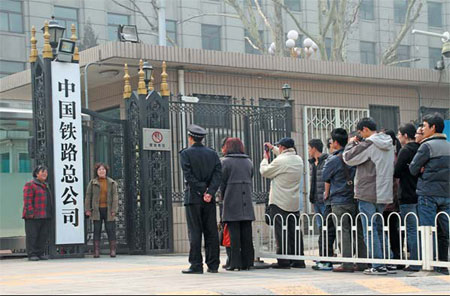 |
|
People line up to pose for photographs at the entrance of China Railway Corporation, a company established to take over the commercial duties of the now defunct Ministry of Railways. Provided to China Daily |
"This lays the foundation for future reforms," said Zhang Guoqiang, a researcher for the National Development and Reform Commission's Comprehensive Transport Institute.
Yet, he warned, "there has to be more substance to this than merely breaking the Railways Ministry into two parts".
Indeed, the dismantling of the ministry has led to questions - and no little debate among experts and industry insiders - about what should come next.
Should the corporation accept private investment? Should fares be increased? And, arguably the most divisive point, should the national monopoly be broken up into regional rail operators to encourage market competition?
Zhang said he believes reform is the only choice for solving long-standing problems within the network, as well as improving efficiency and supervision against corruption.
For example, rail routes in many European countries are connected to seaports, "but efforts to do that in China since the 1980s have come to nothing," he said. "The failure has largely been due to the rigid railway system."
Although opportunities abound, one thing experts agree on is that any changes to the network need to be gradual and made with caution.
Unlike in the United States and many European countries, where the reliance on trains has fallen over the years largely due to a boom in air travel, China's railways still make a "fundamental contribution to the economy and society," said Zhao Xu at the Unirule Institute of Economics.
Stretching 98,000 kilometers, the network is the second largest in the world. Four billion metric tons of cargo are shipped on its tracks every year, including, according to a recent People's Daily report, as much as 85 percent of wood and crude oil supplies and almost 1.7 billion metric tons of coal.
A source with the NDRC said the network employs an estimated 2 million workers, and in 2012 handled 1.9 billion passenger journeys.
It is this lingering dependence on the railways that has led to the cautious tone among many industry insiders.
Late Chinese leader Deng Xiaoping, who identified rectifying the railway system as a key measure to stimulate a stagnating economy during the "cultural revolution" (1966-1976), compared China's reform to "crossing the river while feeling the stones."
But for transport researcher Zhang, there will be no stones to feel. "This reform will be one of trial and error; there is no roadmap," he said, explaining that China cannot follow the model of another country because a railway is unique to each nation's economic development. "We're in uncharted waters here."
Massive debts
In March, the State Council released a statement setting out the duties of the new corporation: Railway dispatch and command, freight and passenger business management, construction and maintenance, and taking charge of 18 railway bureaus nationwide, three transport companies and all other assets owned by the now defunct Ministry of Railways.
 |
|
Workers build a new high-speed railway link between Lanzhou in Gansu province and Urumqi in the Xinjiang Uygur autonomous region. The 1,776-km route is due to start operation in 2014. Cai Zengle / for China Daily |
The commercial enterprise also inherited the ministry's massive debts.
According to authorities, China Railway Corporation was launched with a registered capital of 1.03 trillion yuan ($166.3 billion). Yet at the last count, the ministry was estimated to be 2.60 trillion yuan in the red, mostly built up since 2008 from the large-scale high-speed rail projects.
Investment previously came from bank loans and through issuing bonds; although there now appears to be a consensus among experts that there should be greater diversity in the sources of funding.
The debate over whether to allow private capital investment in rail projects was ongoing before the announcement to dismantle the ministry. In January, the topic was high on the agenda at a work conference in Beijing.
Sheng Guangzu, railways minister at the time but now general manager of China Railway Corporation, told the conference a national fund may be set up to encourage private investment in high-speed projects and to ease the financial burden. He said local governments and State-owned and private enterprises will be encouraged to participate in construction.
It is not certain whether that plan is still in progress after the ministry's separation, but experts say funding solutions need to be found, and found quickly.
For Liu Shijin, deputy director of the State Council's Development Research Center, the key test of whether the reform is a success will be if private investors have access, and are willing to get involved.
The railways "need money and the private sector has a large amount of it that is awaiting approval to enter," he said in a speech at an economic forum in Guangzhou on March 31. "The main problem the reform should solve," he added, "is allowing funding from outside (government channels) and establishing a clear business and governance structure, one that protects the interests of investors."
Again, there are those who urge caution, such as Zhang at the Comprehensive Transport Institute. "We do need to shift funding away from bank loans and State subsidies," he said, but authorities must "carefully consider the national interests involved."
|
|
|
|
|
|
|
|

Copyright 1995 - . All rights reserved. The content (including but not limited to text, photo, multimedia information, etc) published in this site belongs to China Daily Information Co (CDIC). Without written authorization from CDIC, such content shall not be republished or used in any form. Note: Browsers with 1024*768 or higher resolution are suggested for this site.
License for publishing multimedia online 0108263 Registration Number: 20100000002731 













 Op Rana
 Berlin Fang
 Zhu Yuan
 Huang Xiangyang
 Chen Weihua
 Liu Shinan