Synchronised Swimming
Updated: 2012-05-14 18:05:14
( london2012.com)
|
|||||||||||


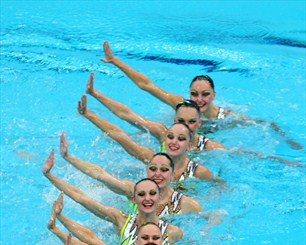
Synchronised Swimming is all about grace under pressure, as athletes use pinpoint precision and immense stamina to deliver beautiful routines in the pool.
Having made its Olympic debut at the Los Angeles 1984 Games, the all-female event will be held at the dazzling Aquatics Centre during London 2012.
 |
Competition dates
Aug?5?-?Aug 10
Competition venue
Olympic Park - Aquatics Centre
Number of medal events
2 - Duet competition and Team competition.
Number of competitors
104. Synchronised Swimming is one of two Olympic disciplines contested only by women (the other is Rhythmic Gymnastics).
The eight countries with entrants in both the Duets and the Teams events are limited to nine athletes in total, from which two compete in the Duets event and eight compete in the Teams event. The remaining 16 countries compete only in the Duets event and are limited to two athletes.
Field of play
Part of the pool used for Swimming events is used for this competition. The area used for Synchronised Swimming is 30m long, 25m wide and 3m deep.
History of Synchronised Swimming at the Olympic Games
Synchronised Swimming grew out of the ornamental water ballets of the late 19th and early 20th centuries, which became popular in Europe and the US thanks to pioneers such as Australian swimmer Annette Kellerman. The first competitions were held in the 1930s, five decades before the sport made its Olympic debut at the Los Angeles 1984.
The basics
Aided by underwater speakers, duets or teams of eight swimmers perform short routines to a musical accompaniment. Judges mark a variety of components during the course of a routine, including choreography, difficulty and execution.
Competition format
In the Duets event, each duet performs a technical routine and a free routine preliminary as part of the preliminary phase. The total combined scores determine which 12 duets progress to the final, where each of them performs a free routine final. The results are determined by the combination of the scores from the technical routine during the preliminary phase and the free routine final.
In the Teams event, each team performs a technical routine and a free routine. The total of the two scores determines the competition results.
Officials
In the technical routine, one panel judges the execution, including the required elements. The other panel is looking at the overall impression: choreography, synchronisation, difficulty and manner of presentation.
In the free routine, the technical merit judges score the difficulty and execution of strokes/movements as well as the synchronisation of the swimmers. The other panel is looking at artistic impression, which includes choreography, music interpretation and manner of presentation.
Keys to success
Although it looks deceptively graceful from the pool side, Synchronised Swimming is an extremely demanding sport calling for great strength, endurance and flexibility. Swimmers use nose clips to help them stay underwater for longer, but the sport still requires tremendous breath control.
Every detail of the routine is judged and swimmers must be perfectly synchronised - all eight of them in the Teams event - if they are to score highly.
Breaking the rules
Judges can award point deductions for a variety of infringements, including taking too long on the deck before the swimmers enter the pool, making deliberate use of the bottom of the pool or missing out any of the compulsory elements of the technical routine.
Jargon buster
Back layout - a position in which the swimmer holds herself flat and face up on the water's surface while sculling.
Deckwork - the initial movements performed by swimmers after the music starts but before they enter the water.
Eggbeater - powerful way of treading water that allows the swimmer to perform arm movements while staying afloat.
Scull - underwater hand movements designed to move and support the body in the pool.







Medal Count |
||||
| 1 |  |
46 | 29 | 29 |
| 2 |  |
38 | 27 | 22 |
| 3 |  |
29 | 17 | 19 |
| 4 |  |
24 | 25 | 33 |
| 5 |  |
13 | 8 | 7 |
| 6 |  |
11 | 19 | 14 |


Most Viewed

Gold medal moments
Age not a problem for Olympic dreams
Olympic moments to remember
Beijing Olympics just keeps on giving
Against the Olympic spirit
Olympic fashion tips
Taking success overseas
Competition Schedule