A family affair
Zhao and Li make up just one of the parent-child combinations attending what are in all but name, math olympiad classes.
"I hope he can win awards at math competitions, after taking the extra teaching, and gain entry to a good middle school," said one father, who would only give his surname as Chi.
His 8-year-old son is the most active student in his class, consistently the first to shout out answers and making a point of discussing the problems with the teacher.
 |
|
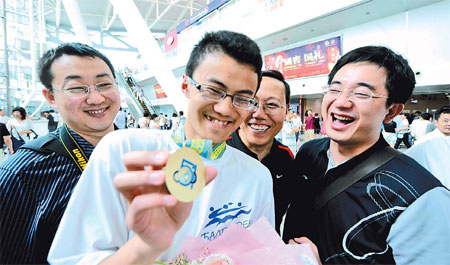
Lai Li, a student from the Nankai Middle School in Chongqing, displays the gold medal he won at an international math olympiad competition in 2010. Provided to China Daily |
Gao Yiran studied for the math olympiad from 2007 to until earlier this year, but has now stopped attending the classes. "The questions were not easy for her, which meant she had to work extremely hard. I don't want her to burn out," said Gao Zhenhai, who didn't expect his daughter to become a mathematician or win international math competitions. "I just wanted her to go to a good school," he said
"I hope she builds on this solid foundation in math. The subject is so important, even in middle school and college," he said. He has spent almost 10,000 yuan annually on his daughter's math training, more than 10 percent of the family's annual income.
While Gao Zhenhai's intention was purely pragmatic, Chi said that math olympiad training helps kids to think logically and can inspire a genuine interest in the subject.
However, Wang Wen, 44, was skeptical that the extra classes would help her son. "I know he is not gifted at math, and I think it's more important for him to discover his own interests rather than feeding him mine or those of society," said Wang.
"Not all kids are geniuses, and I have to admit that mine isn't," she added. "It also costs a lot, so if it's not doing him any good, why force him to go?"
However, some children take it upon themselves to study even harder. Gao Yiran works on one extra math question every day. "Some questions are simple, and I can solve them in 15 minutes, but some are so difficult it takes me almost an hour just to understand them," she said.
The girl also raises her work-rate as competitions approach. "I double the study time in the month before to prepare for the competition," she said. In city-level competitions, students are rewarded if they gain a score of 40 percent or higher. Those with scores above 65 percent are awarded a gold medal.
Igniting passion?
"If there is any way to ignite a passion in kids for science and math, that's good," said Yau Shing-Tung, a Harvard math professor since 1987.
However, he expressed concern that in China, kids are required to memorize and practice the formulae most common in math olympiads.
"There are many areas in mathematics that are ignored by the olympiad. For example, it does not include calculus and as a result, it misses out on a huge area of mathematics," he wrote in an e-mail reply to questions from China Daily.
"The training helps kids, but only to the extent of problems or ideas related to the math olympiad, which in most cases are elementary number theory, algebraic inequalities or identities or combinatorial problems. These are good if the kids actually learn and absorb the ideas. But there are many more areas in math. If the kids also learn the other areas, they will be fine," he added.
Children in the United States cover a much wider range of math-related topics, driven by their own interest in the subject, and they tend to have a wider view of the subject.
"In China, everything is related to examinations. Parents and teachers, the schools and governments only focus on grades. The overemphasis on exams becomes a serious burden on kids with an interest in mathematics or science. They start to feel that they need to do well to make their parents happy."
Yau said Chinese parents see it as a great honor to themselves if their child is successful in math competitions and that tends to put too much psychological pressure on the kids. Sometimes their names even appear on TV or in the newspapers and acclaim at such a young age may not necessary be good for the child.
Lin Yong, a professor at the School of Information at Renmin University of China in Beijing, said that extra training is good for the small number of children who express a genuine interest in math.
"However, some questions are too extreme, too difficult for young students," he said, adding that some are more suited to students of logic than math.
He also dismissed the link between math olympiad results and easier access to good schools. "It is irrelevant. The most important thing is to nurture a love of math," he said.
Lin's opinion was echoed by Mark Saul, director of the Center for Mathematical Talent at the Courant Institute of Mathematical Sciences at New York University, who has more than 40 years experience in math competitions.
"The touchstone of success for olympiads, as for any educational experience, is whether the students engage deeply with the activity and make it their own," he wrote in an e-mail to China Daily.
Motivation levels
Saul said the training is merely a method of motivating a deeper understanding of mathematical concepts and the ability to use them in combination to solve problems.
But it's all relative. "What causes me to love mathematics may cause you to loathe it," he wrote, adding that that motivation can be a highly personal quality, and that he doesn't believe in forcing all kids into extra lessons for olympiads.
 |
|
Reference books for the math olympiad competition on sale at a Shanghai book fair. Provided to China Daily |
One sees this all the time, for example, in musical training (another area where we find prodigies). We find many people with a gift for the piano, who won't touch it as adults because they were pushed as children."
He said students now have more opportunities to enjoy math.
"When I first started (40 years ago), there was not much mathematics outside the usual curriculum. Competition was the only venue for students who needed more mathematics.
But lately, many more programs have been developed, presenting interesting mathematics in different settings, mathematics which goes far beyond the textbook curriculum.
There are mathematical circles and clubs. There are projects and Web discussion groups. All these practices and institutions contribute to students' mathematical growth."
Saul said math olympiad training and competition isn't just about concepts, but is also a way to meet like-minded individuals, something he realized when he took some of his students to a competition in Mexico.
"They (the US and Mexican students) saw mathematics as part of their identity, as individuals and as members of a mathematical community. They drew personal, social, and intellectual sustenance from doing mathematics with each other.
"This phenomenon is perhaps the most important part of the experience. Anything that is fun to do alone is even more fun to do with other people, and the competition threw together just the right people."
Contact the reporter at luowanshu@chinadaily.com.cn
Cao Yin contributed to this story.
|
|
|
|
|
|
|
|

Copyright 1995 - . All rights reserved. The content (including but not limited to text, photo, multimedia information, etc) published in this site belongs to China Daily Information Co (CDIC). Without written authorization from CDIC, such content shall not be republished or used in any form. Note: Browsers with 1024*768 or higher resolution are suggested for this site.
License for publishing multimedia online 0108263 Registration Number: 20100000002731 












 Op Rana
 Berlin Fang
 Zhu Yuan
 Huang Xiangyang
 Chen Weihua
 Liu Shinan