The final journey
Every year, billions of birds across the globe follow established migration patterns from north and south. From early October to December, birds from Eastern Europe, Mongolia and Northern China fly to South Asia via the "Millennium Bird Trail" which passes through Hunan and its neighboring province, Jiangxi. Three of the world's eight major migratory routes pass through China.
The geological conditions in Hunan and Jiangxi make the provinces the only path for southbound migratory birds. "The wintering grounds may vary from place to place, year to year, but the route never changes," said Jiang Yong, who heads the office of the Worldwide Fund For Nature in Changsha, the provincial capital.
Migration is a well-known phenomenon, but scientific research has been unable to provide a convincing explanation of why these "fixed routes" exist, he said. Some experts believe that geographical conditions, wind speeds and air humidity play a key role, while others favor the theory that the earth's magnetic field plays a crucial, if little understood, role in guiding the birds to their winter quarters.
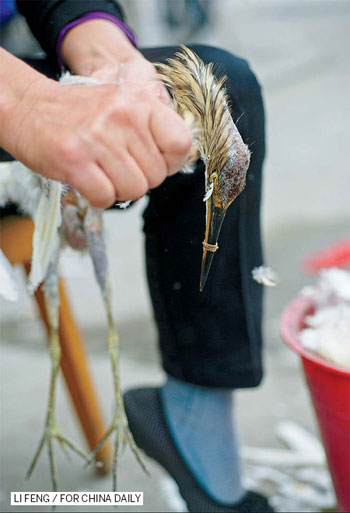
Unluckily for the birds passing through Hunan, their timeworn routes provide rich picking for the hunters. "Most of the birds killed are small and medium-sized," according to Li, who described the flocks as "bird rain". In the period just after sunset, countless numbers of birds fly above the mountain villages where "hundreds of well-prepared professional hunters wait, their lights fully illuminated to attract them. They use guns and homemade cannons loaded with grapeshot that can kill tens of birds in one go."
Once dead, the birds embark on one final journey - to the dinner table. Some of the hunters are so successful that they make their entire year's income during the short migratory season. Diners pay as much as 300 yuan ($48) to eat rare species such as swan in local restaurants. For rural families existing on an annual income of 1,000 yuan, the bird-hunting season is a big deal.
And while some of the birds are sold locally, others are loaded into refrigerated trucks and transported further afield, to places such as Guangdong province, where the locals traditionally have a taste for bird meat.
Qing Dynasty hunters
"Swan tastes fantastic, far more delicious than duck or goose. When I was a child, I ate swan for the first and last time. Unforgettable," said a 50-year-old cab driver in Changsha, who declined to be named. He said he was raised in a village in north Hunan, where bird hunting is a local tradition.
For most residents, the birds are just a delicious foodstuff rather than a rare species. Local amateur and professional hunters kill the birds for nutrition and profit, but wealthy out-of-towners often arrive with their guns, girlfriends and a case of beer to indulge in a little sport.
"In many areas of the country, bird hunting has been a tradition for hundreds of years, as far back as the Qing Dynasty (1644-1911)," said Zhang Houyi, 71, who was born and raised in Yueyang, a city on the shores of Dongting Lake, China's second-largest freshwater body and a famous wintering ground for migratory birds.
"There was a special group of hunters who worked for the emperor during the Qing Dynasty. Migratory birds were only eaten by the royal family and their relatives at that time," he said. The city maintained the tradition of "officially recognized" teams of hunters until the late 1970s. Zhang was a team leader until 1979.
The weapon used at the time was similar to a modern-day mortar, consisting of a number of iron pipes, 3 or 4 meters in length, fixed on a hollow base which was filled with gunpowder. The tubes contained hundreds of small iron balls that could kill even the largest birds with ease.
As awareness of wildlife protection increases in China, traditions are gradually being replaced by regulations, said Qian Fawen, an avian expert at the Chinese Academy of Forestry.
Reports on the movements of various species within even a small geographic area cost tens of thousand of yuan. Meanwhile, detailed cross-continental observations cost millions, but Qian has only received funding of between 100,000 to 200,000 yuan.
"This is why we cannot make hunting legal, because we don't yet have specific knowledge about the number of species," he said.
Habitats under threat
Illegal hunting is just one of the activities threatening the birds as they migrate, said Jiang from the WWF. The destruction of the natural habitat poses an equally grave danger to those who survive the rigors of the journey, the guns and the nets.
The last national wetland investigation, undertaken in 2003, indicated that 1.3 million hectares of wetland were turned over to cultivation during the previous decade, resulting in the disappearance of roughly 1,000 lakes nationwide. Moreover, shrinking water resources and reclamation projects are also eating away at the wetland areas.
The wetlands of the lower Yangtze River provide a winter home for 800,000 to 1 million birds, including the Siberian white crane, which is listed as "critically endangered" by the International Union for the Conservation of Nature and Natural Resources.
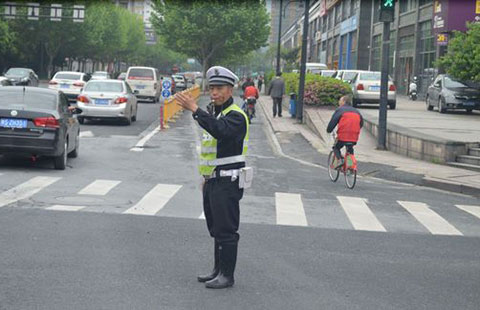
Police forces play a crucial role in the protection of migratory birds. China's Wild Animal Protection Law enacted in 1988 says that anyone who catches, kills, sells, purchases, transports or carries wildlife without express official permission faces fines or prosecution.
The forestry police in Hunan are now screening for illegal activity across the province, while simultaneously stepping up enforcement and supervision of the relevant laws.
Recently, local county governments in Xinhua, Xinshao and Longhui in Hunan province have signed a convention on bird protection in an effort to restrain illegal hunting.
Meanwhile, a series of educational campaigns will urge the general public to pay more attention to the region's wildlife. However, research is still minimal: "Even as an expert on wild birds, I can't tell you the exact numbers or species of the birds migrating through Hunan province. It's embarrassing," admitted Qian.
Tang Yue contributed to this story.



Copyright 1995 - . All rights reserved. The content (including but not limited to text, photo, multimedia information, etc) published in this site belongs to China Daily Information Co (CDIC). Without written authorization from CDIC, such content shall not be republished or used in any form. Note: Browsers with 1024*768 or higher resolution are suggested for this site.
License for publishing multimedia online 0108263 Registration Number: 130349