Schools set the right tone to help young language learners, reports Mark Graham in Beijing.
Few parents like to be corrected, or contradicted, by their children. But there are exceptions to that general rule: Expatriate parents living in China tend to swell with pride when their Mandarin-speaking children point out that mum and dad are totally mispronouncing words, or hopelessly mangling grammar.
Children born in Beijing, or who arrive in the capital at a very young age, have every chance of attaining fluency in Mandarin. It is not uncommon to see blond-haired children chatting away colloquially, having naturally mastered the tricky tones that adult learners find so fiendishly difficult.
For babies and toddlers, chances are they will spend much of the day with their ayi (domestic helpers), individuals who rarely have any language skills apart from their native Mandarin. Some parents ensure that their kids are bilingual by sending them to schools where classes are given in English and Mandarin.
Australian Laura Faulkner, 6, and her brother William, 4, have attended several such schools, allowing them to switch with ease between English and Mandarin. Their Beijing-born sister Tessa, who is 18 months old, can also understand both languages.
When the Faulkner family moved to Beijing four years ago, hotelier father Michael and teacher mother Michelle viewed it as a great opportunity for their children to grow up speaking, reading and writing Mandarin, skills that are almost certain to be major assets on their resumes in the 21st century.
 |
|
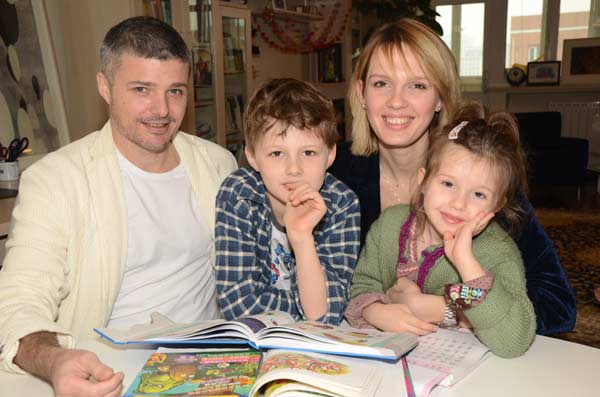
Mathew and Sasha Alderson opted for local schooling for their kids Nik and Natalia. [Photo/China Daily] |
Communication essential
"We thought it essential that they were able to communicate with other children, in the park or in the playground, and we looked for a bilingual kindergarten," said Melbourne-born Michelle, who is also studying the language.
"They now speak the language fluently, have an understanding of Chinese culture and feel at home living in Beijing rather than seeing themselves as visitors. Laura can write her Chinese name, recognizes many Chinese characters, and can write simple characters.
"The other day we were on the way home in the car and she wanted to speak Mandarin, not English, so I tried. She told me that my Mandarin sounds strange. When I asked her what she meant, she said that I don't say it correctly and proceeded to explain. She said I say shu (tree/plant) wrong and demonstrated the correct tone. I repeated it five times but each time she said no, it still sounds strange! Eventually I said: 'I am doing the best that I can!'
"Earlier on, we had times when she refused to speak Mandarin and found reasons not to join in the Chinese activities at school, either because she did not understand, or felt left out. So we had to move kindergartens to find a more suitable bilingual environment. Many say that children learn languages like a sponge, but I still think that there are times when it has been hard work for our kids."
Although the Faulkners' spell in the city will be finite - Michael is manager of the new Swire hotel, East - they are convinced a bilingual education for their children will be beneficial both now and in future.
"The bilingual system is very impressive here," said Michelle. "The facilities and varied lessons that our kids get here are excellent. They have specialist teachers in art, physical education and music, which supplement the bilingual program."
That kind of educational program is not for every family. Some expatriates would dearly love their children to learn Mandarin but realistically, have to stick with schools that offer the language of their native country, be it English, French, German or Japanese, and a curriculum that is broadly similar to that at home.
 |
|
Lachlan (left) and Oliver Dean have benefited from a bilingual upbringing.[Photo/China Daily] |


Copyright 1995 - . All rights reserved. The content (including but not limited to text, photo, multimedia information, etc) published in this site belongs to China Daily Information Co (CDIC). Without written authorization from CDIC, such content shall not be republished or used in any form. Note: Browsers with 1024*768 or higher resolution are suggested for this site.
License for publishing multimedia online 0108263 Registration Number: 130349