 |
|
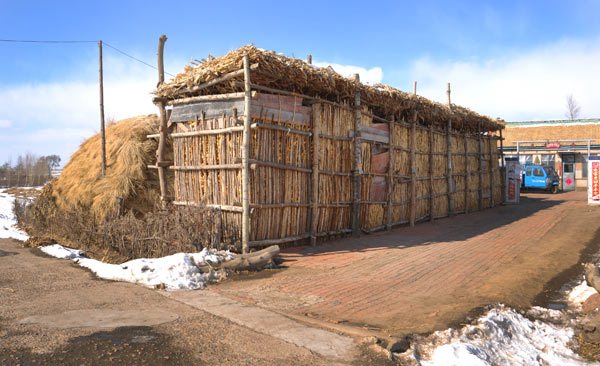
Grain storage is crucial for both the government and farmers. Han Chang'an built a temporary shelter for corn storage last autumn, but found it difficult to keep the grain dry because of the humid climate. He Na / China Daily |
Scientific storage
To reduce losses, the SAG launched a program in 2007 to promote scientific grain storage containers, which are specially designed to prevent the intrusion of moisture, insects and rats.
Under the program, central and provincial governments pay 60 percent of the cost of each container, while farmers pay the remainder.
"By the end of 2010, 2 million households had improved storage conditions. The program resulted in an obvious reduction in losses, and so we plan to increase that number to 10 million by 2015," said He, adding that 10 million is still just a drop in the ocean.
"To lower the cost of the containers, we hope the program can be listed in the government's agriculture infrastructure, under which farmers will be eligible for subsidies."
Li Guoxiang, a senior researcher in rural development at the Chinese Academy of Social Sciences, pointed out that as more young farmers leave the land and head to large cities as migrant workers, their land is being taken over by a small number of large producers and so improvement of the storage facilities would be a practical move.
Qin Fu, director of the institute of agricultural economics and development at the Chinese Academy of Agricultural Sciences, holds a different view. "To reduce losses, we need to gradually change farmers' storage habits and encourage them to sell their crop as quickly as possible. Just as people deposit money in banks, farmers can also deposit their grain with enterprises that have good storage facilities," he said.
In Guantao county, Hebei province, some granary logistics and processing enterprises provide free storage facilities for farmers, who can withdraw the produce when they desire in the form of cash, rice or flour.
Red frames, rotting roofs
Visiting the Yushu Grain Depot in Jilin province feels like stepping back in time: Several rows of red wooden-framed silos dominate the yard. Many were built in the 1950s and some still carry quotations from the late Chairman Mao Zedong painted on the walls.
The dark rooms give off a close, damp smell and some of the wooden roofs are rotting. "These barns are no longer suitable for grain storage. We urgently need new barns, but without money, reconstruction has never really come onto the agenda. It's really a waste of resources, because we have convenient transportation links and a railway runs alongside our facility," said Wei Chunyuan, director of the depot's warehousing department. The other, newer storage facilities are also in need of renovation, he added.
Wei opened the door of a huge silo, built in the 1980s, which was brimful of corn. "It is just a huge room, without an underground ventilation system. When the room is too damp, the only way to dry the corn is to open the windows. It's often the case that the corn at the bottom of the pile goes off, and so a high level of loss is inevitable," he said.
"We need to rebuild the barns, because without decent facilities our lives are miserable. We only receive our salaries once every three or four months," said Wei.
According to Liu Xin, general manager of the Yushu branch of Dalian Northern International Grain Logistics Co, the town has 200 grain-related enterprises. A number of the larger ones have built their own well-equipped barns, but a lack of funds means most of the smaller outfits store their produce in simple shelters.
At Yushu Guangfa Grain and Oil Co, the corn is stored in a temporary brick barn whose inadequate construction allows birds to enter the stores at will, stealing grain and fouling the produce. The store's limited capacity means that some of the corn is simply piled in the yard and covered with blue plastic sheeting, leaving corncobs scattered everywhere.
According to He Yi, the central government has invested more than 30 billion yuan ($4.7 billion) since 1998 to establish a number of standardized grain depots nationwide, accommodating 50 billion kg of produce. These depots are equipped with computerized monitoring and control systems. They provide excellent one-year storage and grain losses can be controlled to within 0.2 percent of the volume.
However, the task of improving storage facilities is far from finished. Many grassroots grain depots are beyond repair.
A town-level depot in Renhuai city, Guizhou province, collapsed in 2009, as farmers were busily selling their produce. The collapse cost 10 lives.
"That bitter lesson taught us that it's imperative that the grain depots should be completely repaired or even rebuilt. We plan to eliminate these dangerous depots within five years, but that will require strong support from the central government," said He.
The world has entered a dangerous period, according to Qin. The international situation remains tense and turbulent and the acreage of China's farmlands has declined rapidly during the past decade, so a potential grain crisis cannot be ignored.
His prescription is simple: Private enterprise should be encouraged to improve grain storage facilities and ensure the safety of the crop. In addition, the government should offer farmers favorable terms or increase the number of loans available to private enterprises to make use of their barns, rather than pouring vast amounts of money into repairing State-owned grain depots.
"Compared with the huge investment in agriculture before the grain harvest, the amount the government pours into the post-harvest period is small. The government needs to increase its input into grain circulation, because reducing grain losses just another way of increasing output," he said.
Contact the reporter at hena@chinadaily.com.cn


Copyright 1995 - . All rights reserved. The content (including but not limited to text, photo, multimedia information, etc) published in this site belongs to China Daily Information Co (CDIC). Without written authorization from CDIC, such content shall not be republished or used in any form. Note: Browsers with 1024*768 or higher resolution are suggested for this site.
License for publishing multimedia online 0108263 Registration Number: 130349