New centers are promoting the arts in China. Kelly Chung Dawson reports from New York.
China's government has in recent years commissioned prominent Western architects and consultants to accomplish its goal of building at least 10 cross-regional performing arts centers nationwide by 2015.
 |
|
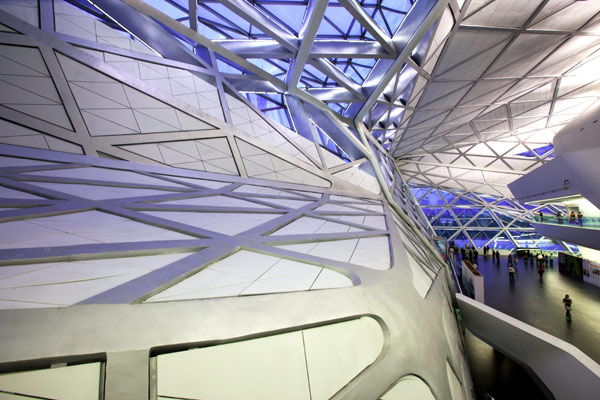
The interior of Guangzhou Opera House. Designed by the Iraqi-British architect Zaha Hadid, the building employs a revolutionary asymmetrical design featuring breakthrough acoustics technology. Xu Ying / for China Daily |
"Culture today is big business," said author and architectural historian Victoria Newhouse.
"With 30 million piano students in China and 10 million violin students, I am confident that these theaters will be full in a few years. Any doubts we have about the future of classical music should be allayed by those statistics," said Newhouse, who included a chapter on China's efforts in her book Site and Sound: The Architecture and Acoustics of New Opera Houses and Concert Halls, published in May.
Diversity of funding
According to Ken Smith, a performing arts critic with The Financial Times, the National Center for the Performing Arts cost $400 million; the Shenzhen Concert Hall cost $200 million - although Xinhua News Agency put the figure at $120 million - and the Guangzhou Opera House came to $200 million. But the funding sources for these projects are so diverse - including state, provincial, county and municipal - that it's difficult to estimate how much the government has spent in total on the centers, he said. International funding is also part of the equation, but is not always officially announced.
Newhouse, who is the founder of the Architectural History Foundation, believes Chinese development will mirror the 1970s spike in museum construction in the United States. During a recent panel discussion in New York, Newhouse recalled the "dusty, musty old places" museums used to be.
"No one went to museums in the US, and when you look at the lines that wrap around the block today, it's hard to remember back to when museums were considered boring places," she said. "But the construction of that time had an absolutely electrifying effect on attendances, which we know now. The architecture had a great deal to do with it, and I am hoping that this burst of construction of music facilities in China will have the same effect on classical music audiences."
There is already evidence of a changing tide, she said. "It's becoming a hot topic, and, worldwide, concert halls seem to be replacing museums as the iconic building that every community wants to have."
In China, two factors have driven this phenomenon, according to Newhouse: government support and intercity competition. Shanghai and Beijing have impelled each other to construct bigger and better performing arts venues, with the cities competing to sign contracts with top architects. After the French architect Paul Andreu designed Shanghai Oriental Art Center, Beijing came calling for him to lead construction of the National Centre for the Performing Arts - evidence of healthy competition, Newhouse said.
Smith, who has traveled extensively in China, concurred. "The farther you get from [China's] east coast cities, the more civic pride takes over," he said. "But in those east coast cities, it's a way of asserting themselves internationally and adding to China's soft power.
"They know culture is a big thing in being taken seriously as a major power. They know that a lot of political discussions take place in the soft-power realm. There's an idea now that places like China have realized that they have cash, and opera houses in Italy, for example, don't, but they do have the expertise. That's led to some very interesting international collaborations."
In 2011, New York City's renowned Lincoln Center for the Performing Arts announced a business deal with China's State-owned Tianjin Innovative Finance Investment Co to consult on the planning of a Tianjin performing arts complex over three years. At the time, Lincoln Center spokeswoman Betsy Vorce said the collaboration had been initiated partly to foster exchanges between Chinese artists and organizations and their US counterparts. Lincoln Center was unwilling to disclose financial details of the deal.
Francesca Zambello, an internationally respected director of opera and theater, was commissioned by China's National Centre for the Performing Arts to direct a production of Georges Bizet's Carmen in 2011.
"I think this is a major focus for [the Chinese government]; they want to expand to bring Western culture to China," said Zambello. "But I don't think they are doing it at the expense of developing their own culture.
"Chinese opera (traditional Peking opera) is a rich, beautiful tradition, and I don't feel like they're losing sight of that. I do feel that they're very serious about this. They're not dabbling, and they want to learn. I respect that."
|
 |
|
Guangzhou Opera House opened on May 9, 2010. Yao Shengbo / for China Daily |
Steep learning curve
Zambello's experience on the production was rewarding but exhausting: "Bringing European culture to the Chinese requires a big learning curve. It was very difficult. They're not used to dealing with foreigners. Often the administration would say 'Yes, Yes, Yes' but then nothing would happen. They didn't want to say 'No'. It's the same in Japan.
"But I will say that working with the Chinese, I saw that they are very willing and they work hard. In so many places in the world, they will say 'This is just how we do things', but in China they really want to learn."
During the production, the Chinese performers were still learning to sing in the Western style, she said. Carmen, first staged in 1875, requires a sultry vibe, and it took a while for the Chinese performers to feel comfortable enough to touch each other on stage, she said.
"But in the end, I had to tell them to get their hands off each other," Zambello said with a laugh. "Ultimately I really loved the experience, and it was very moving for me."
Venues are a major factor in how the performing arts develop, Newhouse said. "In the West the emphasis is on natural acoustics, so that is the focus of the architect. But in China the natural acoustics are not as important. I think the Chinese are used to amplification. The theory is that this custom of amplifying almost everything originated during the 'cultural revolution' (1966-76) when slogans were constantly being broadcast, and that a taste for amplification developed during that time."
Carl Rosenberg, an acoustics expert for the consultancy Acentech Inc, who traveled to China with Newhouse, said the trend is to build all-in-one complexes that can accommodate theater, symphony orchestras and opera. In the West, these are usually performed in separate halls built specifically for the required acoustics and staging of each form, he said.
"The grand theaters in China try to do it all, and a space which will be used for Chinese opera one night will be used for a grand symphony the next," he said. "That's a very challenging acoustic requirement. I don't want to be presumptuous in saying that the value or quality is not good, and I would say that more often than not for the programs they are presenting it's quite successful. Most of their productions are amplified, and overall the sound quality is good."
 |
|
Illuminations at the National Centre for the Performing Arts in Beijing during the celebrations to mark the 60th anniversary of the founding of the People's Republic of China. Feng Jun / for China Daily |
Frustrations
Often, the architects commissioned to build these centers aren't from a musical background, Zambello said. "They've hired amazing architects for whom I have great respect, but they don't work in what we do, so they don't have a connection," she commented. "There are many impractical things about the way the buildings are set up. That's very frustrating, but anyone who works in theater will tell you that in the US too."
On the upside, there is room for experimentation that might not always be possible elsewhere, Newhouse said. She pointed to Iraqi-British architect Zaha Hadid's Guangzhou Opera House, which employed a revolutionary asymmetrical design featuring breakthrough acoustics technology. However, Hadid was the "winner" of the region's fourth competition to design the center, making it clear that the competition was ultimately only a pretext for local government to select its own designer, she said.
Other complications have emerged because of timing, Smith said. "Sometimes performing arts venues will be completed and then lie dormant for a year," he said. "They'll decide on the Vienna Philharmonic, and then say, 'Can we get them in three months?' They have a sense of reality that on the one hand is very connected to how the rest of the world looks, but is very remedial in terms of how the rest of the world actually functions."
"It's not an organic growth; they are building the halls at the same time as they are building the audiences for the halls. In America, they built halls because the audience had outgrown a previous hall, and orchestras developed a sound based on their own halls. But the audience and the halls don't actually exist yet in China."
In the United States, the arts, and public and private investment in them, first developed in major metropolitan cities before moving to medium-sized regional centers. In China, the initial wave hasn't even died down but the second wave is picking up, Smith said.
Other people have seen project plans fall apart as supporters have fallen out of favor politically, he said. But as funding models for the arts in Europe and the US have struggled over the past decade, China might ultimately provide a path for the future, he said.
"China is being expected to do something that we (the West) don't even seem to have a successful model for yet," he said. "So they have to find popular support for international art forms that have never really had a broad audience in China, and what they do might change the dynamic worldwide.
"It might have to become more Chinese for Chinese audiences to embrace it. International people will have to accept that the product might not look the same way it does back home; it's going to look different. But if China can make it work, the rest of the world will follow."
Contact the writer at kdawson@chinadailyusa.com


Copyright 1995 - . All rights reserved. The content (including but not limited to text, photo, multimedia information, etc) published in this site belongs to China Daily Information Co (CDIC). Without written authorization from CDIC, such content shall not be republished or used in any form. Note: Browsers with 1024*768 or higher resolution are suggested for this site.
License for publishing multimedia online 0108263 Registration Number: 130349