Foreigners returning to the home of their ancestors can experience identity issues, Peng Yining reports.
Being an expat in China can be tough if you happen to look Chinese. When John Kung, a 50-year-old Chinese Canadian, first arrived in Beijing in 2002, the only Mandarin phrases he knew were ni hao (hello), and wo e le (I'm hungry).
 |
|
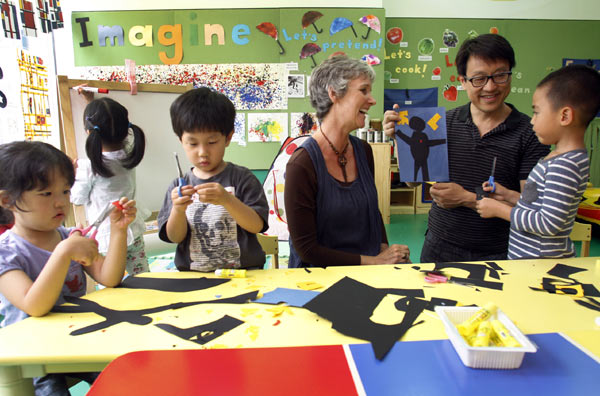
Chinese-Canadian John Kung interacts with students and a colleague at his school in Beijing. Kung says he will stay in China for at least another five years. Photos by Zhang Wei / China Daily |
"When I wanted to order in a restaurant, I had to nudge my friends for help," he said. "Waiters must have been confused, especially when I was having dinner with other foreigners, because I was the one who looked Chinese but couldn't speak the language."
Now, after 10 years in Beijing, Kung can deal with basic conversation, but said he still finds himself at a loss when the topic of his origins arises. If he speaks English, people might think he's strange, he said. If he switches to Chinese, people usually want to know where he's from, because of his accent.
"When they find out, they tell me, 'No, you are not Canadian. You are always Chinese'," Kung said. "It's very hard to explain, so sometimes I tell people I am from South Korea and they're satisfied."
China's surging economy has prompted an increasing number of descendants of Chinese emigrants to return to the home of their ancestors. However, for most, looking Chinese doesn't make them any less foreign. Their background certainly helps, but also brings cultural frictions that other ex-pats don't experience.
"After speaking with me, people in China would say, 'You're not very Chinese'," said Mary Chang, a Chinese-American who studied and traveled in China in the mid-1990s. "I'd sometimes get mini-lectures on how I should be able to speak and write Chinese better."
Chang said her ethnicity and language skills helped her navigate the actual traveling - how to get where, what dishes to order at a restaurant, that sort of thing. But she didn't understand some of the cultural clues - When is it OK to haggle? Is it OK to buy train tickets from a scalper if the ticket window is sold out? She wasn't clued up on how the systems worked and what was expected and what wasn't.
"Because I didn't grow up in China, I ultimately felt like an outsider. Even though I felt claimed as "Chinese", my perspective and thinking tended to be quite different, which sometimes made it hard to relate to the people I met in China," said Chang, who now lives in New York with her husband.
Culture difference
Rather than the language barrier, the experiential and cultural differences seemed huge and values appeared vastly different.
Carol Chow, a 40-year-old Chinese-American who has been living in Beijing for seven years, is almost fluent in Mandarin. "But, because my Chinese is OK, people think I understand everything, but sometimes I don't," she said.
|
 Chinese-American Carol Chow at her cake shop in Beijing. |
Sometimes it's because people speak too quickly or the topic is deep, but more often misunderstandings are the result of a lack of cultural affinity.
Two years ago, Chow opened a cake shop in Beijing and was surprised when customers wanted to bargain over the price. "I hate haggling. I'm not used to it and it's not in my personality. I don't even buy clothes in China, because I don't want to bargain for them. You think you'll save money by haggling, but they just start at a higher price. I don't want people coming into my shop and trying to bargain with me over a cake," she said. "The price is the price. I don't want to add an extra zero. So either you buy, or you don't."
People were confused when Chow explained that she was from the United States and that haggling is not part of her culture, but most still bought the cakes.
Despite the cultural glitches, she is determined to stay in China for an extended period so her 6-year-old twin daughters can learn Chinese. "They can't really learn Chinese in the United States, and it would be useful to them," she said.
According to a report from the Ministry of Human Resources and Social Security, the number of foreigners who stay in China for at least six months rose to 600,000 in 2011 from less than 20,000 in 1980.
The rapid economic development and low cost of living make China a land of opportunity for people from across the world, and are the main reasons for the reverse flow of ethnic Chinese.
"I couldn't believe how much China had changed when I came here in 2002," said Chow who traveled around the country in the 1980s and '90s. "In the old times, people all wore the same clothes and there were no opportunities. If you had asked me at that time if I would like to move back, it would have been like asking me to live on the moon. It was that far," she said.
When Chow decided to move to China, her mother thought the idea was "crazy". Her mother, who worked as a geologist in China, was employed as a maid when she moved to the United States. "She was already 39 when she first came to America. Her English was never that good," said Chow. "Now, she is living with us in Beijing and likes China even more than I do. I guess she never thought she was part of American culture. Now she feels Chinese again and she is more herself here."
Kung said his father, who's originally from Hong Kong but emigrated to Canada in 1967, was happy that his son had decided to "return" to China, and gave him a list of do's and don'ts. "Being the child of Chinese emigrants, you always get helpful advice," said Kung. "My background also helped me understand how to do business in the country, like guanxi (connections)."
He said the good news is that doing business in China in not all about connections anymore. "Generally, it's fair for Chinese and foreigners. If you work hard, there will be rewards," said Kung.
In 2002, he opened an English school in a rented apartment in Beijing, with five students and one teacher. Now, the school has four campuses in the capital with more than 250 students. "Business-wise, Canada is a small country. If I returned right now, I would get a job and have a decent salary, but life would be boring," he said. "But in China, my life is fun. There are always things happening. In a city like Beijing, you can find people from all over the world. In supermarkets you can buy as many products as in North America. In an international place like this, you can taste a little of everything," said Kung.
Now his 20-year-old son is attending a one-year exchange program at Tsinghua University in Beijing, studying the Chinese language and culture.
Kung said his life in China is quite comfortable, but sometimes the differences in culture and educational philosophies can make doing business a bumpy ride. "Some Chinese parents ask how many words their kids have learned or if the education here will help them to do well in examinations," he said. "I tell them the children will learn the vocabulary sooner or later, our goal is to acquire knowledge through English, by using the language in daily life."
Kung said he learned about "being patient" from his family and his experiences in China. "Doing business in China, you have to be patient and believe everything is going to work out," he said.
Chinese background
Chow also finds that her Chinese background is helpful for her business. She said if she was totally foreign and unable to speak Chinese, it would be a huge hurdle. But at least she can communicate with people, and that definitely makes her work and life easier.
However, she doesn't think like a Chinese person. "I can't remember Chinese names. I've tried, but can't do it. It's like a mental block," she said. "My Chinese friends view me as American, but my foreign friends see me as Chinese."
James Wong, a 28-year-old freelance photographer who was born and raised in the US, also has the feeling of being "stuck in the middle".
"People look at me and start to talk in Chinese. I've been in China for four months, and my most-used phrase is wo bu shuo zhongwen (I don't speak Chinese)," he said. "Other foreigners I meet often assume that I will know more about China than them, because of my ethnicity. But I am totally clueless.
Most foreigners stay in China for short periods, but there are some who marry Chinese and stay long term. "I think I wanted to go when I was young, partly because my parents brought me up speaking Chinese and I was curious. I grew up mostly in the Midwest, so there weren't many other Chinese-Americans around, so although I felt very American there was a part of me that wondered what life was like in Asia," said Chang.
However, the language and cultural barriers are not the only problems for foreigners in China. Chang said the pollution was so bad in Nanjing, capital in Jiangsu province that the skies were gray almost every day and it was tough to go anywhere without being affected by the pollution. "I remember coming home and just touching my face and finding my fingers all sooty," she said. "I got pretty sick there, and it was partly that experience that made me think it might be tough to live there long term."
Kung said he plans to stay in Beijing for probably five or 10 more years, but will eventually return to Canada, which has the landscapes and seascapes he loves. It's comfortable living in Beijing, he said. Most people he's encountered have been generous and helpful. His Chinese friends help to translate everything, even jokes over dinner, to make him feel at home. "But I just don't get it," he said. "Culturally."
Contact the reporter at pengyining@chinadaily.com.cn


Copyright 1995 - . All rights reserved. The content (including but not limited to text, photo, multimedia information, etc) published in this site belongs to China Daily Information Co (CDIC). Without written authorization from CDIC, such content shall not be republished or used in any form. Note: Browsers with 1024*768 or higher resolution are suggested for this site.
License for publishing multimedia online 0108263 Registration Number: 130349