Body blows
The issue of water safety has been in the spotlight recently after a report in the Century Weekly magazine earlier this month quoted unnamed industry insiders who said only about 50 percent of the water in urban areas actually meets the required standards.
 |
|
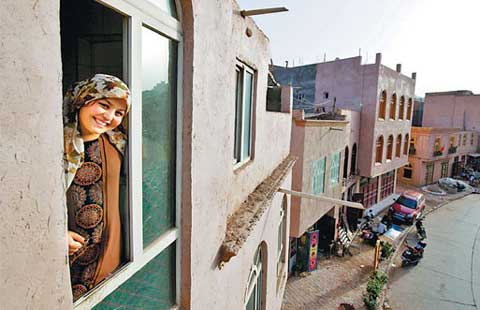
Wei Shubing (left) and his wife must use bottled water for cooking after Longjiang River was cotaminated by cadmium in January, affecting residents of Liuzhou city in the Guangxi Zhuang antonomous region. [Photo/provided to China Daily] |
A second body blow was delivered by Dong Liangjie, an expert in heavy metal pollution in water and a former researcher at the University of Hawaii. Quoting a paper recently published in a scientific journal, Dong claimed that researchers have found contaminants in all 23 water-testing areas that, under certain conditions, can produce effects similar to contraceptives.
Meanwhile, other experts said that, given the severely polluted state of the source water and the ineffectual treatment processes, less than 50 percent of the nation’s tap water reaches the required standards.
In response, officials from several areas went on the record to say that tap water is safe to drink, in their provinces at least. The figures they released were all higher than 95 percent, a huge increase on those quoted by most media.
Four days after the Century Weekly magazine report was published, Shao Yisheng, director of the monitoring center of the Ministry of Housing and Urban-Rural Development, released the latest official safety figures: 83 percent. Shao cited a survey conducted by the ministry in 2011, but didn’t reveal the locations of the 17 percent that failed to meet national standards.
"The water quality in cities such as Beijing and Shanghai is relatively stable, but for residents of small cities, 50 percent or 83 percent doesn’t really mean anything."
Netizens were dissatisfied with Shao’s figures and asked for more information, including the locations where the water quality failed to meet the standards. They also wanted to know what measures have been taken to rectify the situation, but the ministry has turned down requests for interviews on the topic.
Source-water quality
The safety of tap water is dependent on many factors, the most important being the quality of source water, according to experts. The latest figure, released by the Ministry of Water Resources, is 80 percent nationally. But Century Weekly quoted Song Lanhe, another official from the ministry’s monitoring center, as saying that the rate is actually closer to 50 percent.
"Much of China’s source water is now surrounded by residential buildings, especially farms," said Tsinghua University’s Fu. "The increase in annual agricultural output is supported by the use of huge amounts of chemicals and fertilizers, which will definitely enter the water table and contaminate our source water."
Meanwhile, sewage dumped into rivers by chemical plants has also played a major role in changing the main pollutants from micro-organisms to organic compounds and heavy metals, many of which are toxic. "The facilities and equipment currently used in water plants were able to remove source-water pollutants efficiently before the 1980s, but they can’t deal with those we face now," said Li.
The nation’s antiquated pipeline network is another thorn in the side of those seeking to improve the quality of the water supply. Statistics released by the China Institute of Water Resources and Hydropower Research suggest that approximately 6 percent of the pipes have been in use for more than 50 years. "The water quality decreases by about 10 percent during this (delivery) process," said Wang Hao, head of the water resources department at the institute, according to a recent report from the Xinhua News Agency.
"The levels of bacteria in the pipes increase tenfold every decade. Some corrosive substances in the pipes may also be absorbed by the water," said Zhao Feihong, a researcher at the Beijing Institute of Public Health and Drinking Water. Projects to replace the older pipes are currently ongoing nationwide, but China’s vast landmass means the situation will take a long time to rectify.
Other dangers lurk unseen too: To guarantee adequate water pressure, buildings higher than six stories usually utilize a holding tank on the top floor. The system, known as 'gravity feeding" works well, but can become a health hazard if not carefully maintained. "These water tanks usually lack a regular sanitation management regime and are often loosely sealed," commented Lan Weiguang. "Green moss, bacteria and even the bodies of small animals are often found in them."
Low levels of funding
According to insiders from the Ministry of Housing and Urban-Rural Development, the fundamental problem in maintaining water quality is the low level of low level of funding. "Investment is far from sufficient in this sector," they said.
Those insiders received support from a number of experts. The problems inherent in the treatment process, the pipes and water tanks can be solved with the existing technology, they said, but there simply isn’t enough money invested in the system to provide that technology.
That problem is compounded by the fact that even raising the water quality indicator by one degree results in spiraling treatment costs. Industry insiders told Xinhua that testing all 106 indicators in one sample costs 15,000 to 20,000 yuan ($2,370 to $3,160). And as all of the indicators must be tested at least once a year, and others on a monthly or weekly basis, that sort of money is beyond most cities at present.
Contact the reporters at wuwencong@chinadaily.com.cn or zhengjinran@chinadaily.com.cn


Copyright 1995 - . All rights reserved. The content (including but not limited to text, photo, multimedia information, etc) published in this site belongs to China Daily Information Co (CDIC). Without written authorization from CDIC, such content shall not be republished or used in any form. Note: Browsers with 1024*768 or higher resolution are suggested for this site.
License for publishing multimedia online 0108263 Registration Number: 130349