The population factor
Despite equally strict quality requirements in both cities and rural areas, one of the greatest differences in the provision of safe drinking water is the discrepancy of population distribution.
"In rural areas such as Sichuan, where a certain percentage of the population lives in inaccessible places in the mountains, the discrepancy becomes massive," said Zhang. "In some rural areas, the population density can be as low as 700 people per square kilometer."
 |
|
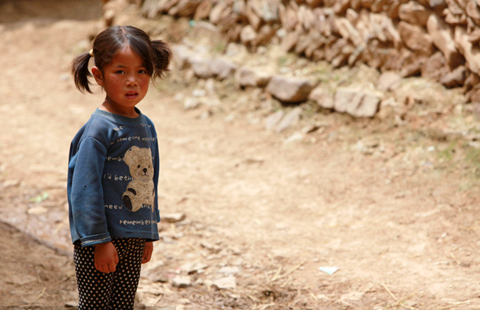
Huang Xilin, from Tasha village in Changning county, is pleased that his water now comes directly from a tap. He said before the arrival of pipeline supplies, people in his village often drank untreated water and fell ill as a result. Liu Gang / for China Daily |
Zhu Bing, deputy head of the Sichuan provincial department of water resources, said the government had previously set up many scattered small-scale water supply projects because of the low population density in many rural areas. "But we learned that although construction of small-scale projects is much easier, the post-regulatory work on water quality becomes a major headache," he said.
As a result, the construction of large-scale centralized water supply plants has turned out to be indispensable to future development. "In the next five years, extra centralized water supply plants will be built to cover more than 70 percent of the population in rural Sichuan," said Zhu.
In 2010, Gou Zhuyao's family was among the first in Dashiqiao village, Suining city, to drink tap water. "We used to pump water from the well in our yard. It tasted bitter, not as sweet as the tap water now," said the 75-year-old who lives with her 80-year-old husband.
As the other family members are away working in South China's Guangdong province, the elderly couple pays about 12 yuan per month for tap water, that's about 1.8 yuan per cubic meter.
When asked about the fee, Gou smiled and said that it wasn't a burden on her family, "Pumping water from the well also cost (in terms of) electricity."
County versus city
However, not all villagers in Sichuan welcome paying the fee for convenient tap water. Zhang said the average tap water fee in the rural areas is 2 yuan per cu m, twice that in the downtown areas.
"In some remote areas, the fee can be as high as five yuan per cu m," he said. "It is far too much for farmers without a fixed income to cover."
Zhang added that the price is a result of the high unit cost of water delivery to rural areas. For example, a 1-km-long pipe may provide water for 10,000 people in a city, but the same pipe would only cover a few hundred in the rural areas. "We hope the water plants can run in virtuous circles by themselves and not be a burden to the government in the future," said Zhang.
Another factor raising the price of water is the high cost of laying pipes in the mountains. "The standard national subsidy is 400 yuan per person in Sichuan, but in many cases, especially in the mountain plateau area in the west of the province, at least 800 yuan is needed to solve the problem,"
Zhang said that even if the province had sufficient funds, about 20 percent of the population would still be denied access to a centralized water supply because of the geography of the area. The only way to tackle the problem is by using diverse water supplies from wells and cisterns.
Zhu Bing, from the Sichuan department of water resources, said the government has a number of projects in readiness, including the selection of a "responsible person" to ensure the safety of the wells and cisterns and also the water quality. Local sanitary and water resource departments will also be urged to monitor water quality on a monthly basis to make sure that the prevailing standards are adhered to.
Contact the reporter at wuwencong@chinadaily.com.cn


Copyright 1995 - . All rights reserved. The content (including but not limited to text, photo, multimedia information, etc) published in this site belongs to China Daily Information Co (CDIC). Without written authorization from CDIC, such content shall not be republished or used in any form. Note: Browsers with 1024*768 or higher resolution are suggested for this site.
License for publishing multimedia online 0108263 Registration Number: 130349