|
|
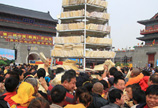
Residents in Tianjin buy potatoes in a market that supports farmers from Inner Mongolia. The shoppers get a discount, too. Zhang Chaoqun / Xinhua |
War with wholesalers
"The turmoil in the jujube market makes us farmers bite the bullet," said Ma Guojun, a planter at Alaer Farm who has cultivated 15 hectares of jujube trees for six years. "An unexpected, shocking low price," Ma said. "I've never seen the price of Xinjiang jujubes so low before."
Ma blamed wholesalers and packinghouses from inland China that wait things out and "deliberately lower the price".
Jujubes have a short window for sale and eating fresh, and are vulnerable on long trips to market. A bad jujube can cause a truckload to rot within a couple of days. Farmers' best option, then, is to dry them on sandy fields. In less than three weeks "under the dry winter sunshine in southern Xinjiang, . . . a jujube will lose 30 to 40 percent of its water content," Ma said.
"Farmers have no time to wait for the price to rise, as rain or snow can easily damage our whole year's hard work," Ma said. "Selling them as soon as possible is the only way out." The wholesalers get good-quality dried jujubes for less money.
"It's like a tug of war between farmers and wholesalers every winter, and we farmers are always the underdogs."
Toll of inexperience
Xinjiang has a relatively short history in large-scale planting, said Yang Zhiyong, head of the Shanxi Jujube Wholesalers Association in Aksu prefecture. Hotan in Xinjiang introduced saplings from Henan province in 2000 and Aksu from Shanxi province in 2005.
Since then, jujubes have become a pillar industry and cash cow for future economic development in poverty-stricken southern Xinjiang. But the farmers still "lack both planting and marketing experience", Yang said.
The threshold for providing jujubes directly to supermarkets is still too high and complicated for individual farmers in Xinjiang, according to Lin Shu'an, who has worked in wholesale fruit more than 20 years. "Processing, preserving, transporting and marketing . . . All these need money and technology. Farmers here are too weak to manage it."
Lin, originally from Henan province, opened a jujube packinghouse in Alaer city in 2006. It has a processing capacity of 500 tons, but he said it can't match jujube production, which grew this year to nearly 134,000 hectares in Aksu.
"Over 80 percent of Xinjiang's jujubes are packaged inland. Thus, most of the benefits gained from them have been gained by inland intermediaries," Lin said.
Despite the drop at wholesale markets, retail prices of top-quality Xinjiang jujubes remain high - roughly 160 to 200 yuan a kilo at dried food markets in inland China. Yang figured the average retail price at 120 yuan a kilo for Xinjiang's jujubes, compared with 6.5 yuan for the same variety from Shanxi.
Yet the lack of experience and proper management made many Xinjiang jujube planters lose in the inland market, Yang said.
Deciding in a vacuum
The rising cost of living has triggered a ripple that affects growers who want to sell their produce in cities' markets. They pay higher market administrative charges, more in rent for market stalls and so on.
Speculation through price fluctuation is a real lure to them.
Predicting a market, whether for produce or stocks, is always tricky. But most farmers don't have access to enough information to make an educated guess. Many had limited schooling, they aren't equipped to check information via computer, and local agricultural offices are often less active than their counterparts in other countries.
For example, said Wang Chuan, the agricultural information researcher, farmers around Hebei province's Shijiazhuang planted 40 percent more land in Chinese cabbage this year because prices last year reached 3,500 to 3,800 yuan per mu on average. Then the price slipped to the current 500 to 600 yuan, about a half-yuan for each cabbage.
"The price of a regular pack of fertilizer has grown from 180 yuan to 200 yuan," Wang said, "and the labor cost in the fields almost doubled in a year. Nothing is left in profit for the farmers."
Zhang Tingyin, an economics professor at the Henan Provincial Committee Party School, calls their problem "information asymmetry." He explained: "They didn't realize many competitors were doing the same thing when they expanded the growing of crops that they felt strongly would go up in price. They just followed their sense of intuition."
Li Guoxiang, from the Chinese Academy of Social Sciences' Rural Development Institute, said the farmers based their decisions on market price at the time, "whereas the relation between supply and demand reversed when the commodity was placed in the market, and it easily led to the significant price fall."
Four ideas
In keep such predicaments from recurring, Wang Chuan suggested that governments help to establish more rural cooperatives. "Such cooperatives gather growers together in collectivized planting and selling, which will lower the cost and reduce the risk for the scattered production."
Wang said that by the end of June, the country had established some 446,000 rural cooperatives. But only 36 million rural households, 14 percent of the total, had joined such civil organizations.
In Henan province, local governments have helped in the formation of nonprofit associations or other groups such as the watermelon or garlic association. Their strengths are in providing information and training to help farmers avoid market risk.
"They work to a certain extent because farmers can timely acquire accurate market information," Zhang said. "Diesel fuel, highway tolls, packing costs . . . the farmer's margin has been squeezed in almost every channel."
From March to May, the Ministry of Commerce issued consecutive regulations urging authorities to allow growers to sell raw agricultural products in urban communities after a quality check. But some cities' restrictions don't support such independent operations.
"The farmers expect more preferential policies to better fall into place," Wang said.
Japan is one of the countries that have maintained stable market prices. The government has encouraged centralized trade for agricultural produce, which allows easier price adjustments. The government also is quick to disseminate information about supply and demand to both farmers and consumers.
Cang Wei contributed to this report. Write to the reporters at qiubo@chinadaily.com.cn and shaowei@chinadaily.com.cn.


Copyright 1995 - . All rights reserved. The content (including but not limited to text, photo, multimedia information, etc) published in this site belongs to China Daily Information Co (CDIC). Without written authorization from CDIC, such content shall not be republished or used in any form. Note: Browsers with 1024*768 or higher resolution are suggested for this site.
License for publishing multimedia online 0108263 Registration Number: 130349