|
 Rescue personnel evacuate passengers trapped in a train carriage. Xinhua News Agency said most of the injuries were bruises and broken bones, with some external head traumas. [Photo/Xinhua]
|
Considering the millions of passengers who travel by subway every day without incident, underground trains are relatively safe. Try telling that to the 284 passengers who were injured on Tuesday in the Shanghai subway crash.
Or to the experts who have seen a rise in problems and accidents on the subways in China. More are anticipated as cities compete to have the newest, biggest and most quickly built subways in the country.
The need to travel in the city efficiently and rapidly sends many passengers underground, far from the madding crowds and traffic jams.
But the rapid pace of opening and expanding subways in China thwarts the sound planning that is needed, experts say.
Zhang Yan, secretary-general of the China Civil Engineering Society, put it this way: "A subway is the comprehensive exploration of space, which requires time for prudent investigation and planning, or else it will lead to irreparable damage to society and the environment."
Shang Rupeng, 31, worries about irreparable damage to himself. He loves subways, and he bought his apartment in Shenzhen largely because it is just five minutes' walk to the Bao'an Center station. But since Sept 12, he would rather risk traffic congestion on surface streets and tardiness to business appointments
Power failed on the subway he was riding on that Mid-Autumn Day. "He told me he thought of the Wenzhou train crash on July 23, which killed 40 and injured about 200, and the idea of death flashed in his mind," his wife, Liu Ting, said.
"I still have the jitters when I remember that I had been trapped in the totally dark and stuffy train carriage," Shang said. "I will never forget the scene. People rushed crazily into the first few compartments for fear of a rear-end collision."
Nobody was injured and the crash Shang feared that day didn't happen. But it did on Tuesday below Shanghai. A subway train on Line 10 crashed into a stalled train in the tunnel that links Laoximen and Yuyuan Garden stations. Signal failure is being blamed.
The wreck of the high-speed trains in July involved one train hitting a stalled train. A preliminary investigation cited a design flaw in a signaling system.
There have been other problems in and around subways in China: breakdowns, electricity failures, signal errors, collapsed tunnels and water leaks. In Beijing on July 5, a rising escalator suddenly reversed direction; a 13-year-old boy died and 28 people were hurt.
Those are results of the nation's expensive rush to build subways, experts warn. They say it's time for the government to reduce the pace of construction and pay more attention to the risks and to hidden problems.
|
 Photo/Xinhua
|
Millions of reasons
The Ministry of Public Security reported that by the end of August, the number of autos nationwide topped 100 million for the first time. Total vehicles reached 219 million. It's no wonder, then, that officials and citizens look underground to escape traffic congestion in more and more cities.
Subways offer some obvious advantages to motor vehicles on roads. They move people efficiently. They run on electric power, which pollutes less than fossil fuels. Overall, they are safer.
And they are popular. Shanghai's subway operating company reported that its record is 7.15 million trips in one day and annual capacity is 2.3 billion, which is 1.8 times China's total population. Beijing Rail Traffic Control Center said passenger flow on its network hit a record on Sept 9 of 7.57 million, more than double the population of Los Angeles.
The latest report by China International Capital Corporation shows that as many as 36 cities in China have submitted plans for subway construction, including more than 20 cities where subways already operate or are being built.
Recognize for a moment that the world's first subway opened to traffic in London in 1863. The total lengths of subway lines in three other top world cities now are 304 kilometers in Tokyo, 286 km in Moscow and 221 in Paris. Based on each domestic city's subway vision, China will have nearly 20 cities with subways longer than those three cities within 20 years.
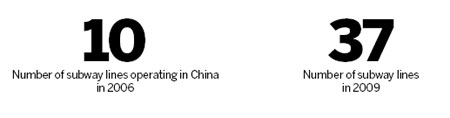
"With a yearly increasing subway length of at least 100 kilometers, China used 10 years to finish the work that developed countries did in 100 years," said Wang Mengshu, an academic at the Chinese Academy of Engineering and a professor at Beijing Jiaotong University's tunnel and underground engineering research center.
"We have reasons to be proud," he said, "but many problems cannot be neglected."
|
 Women who had been riding the Shanghai subway on Tuesday afternoon await treatment in ambulances after one subway train rear-ended another, which had stalled on Line 10. [Photo/Reuters]
|
No universal design
"One serious problem I have observed is copycat subway designs. The plans from design institutes for different cities are more or less the same in route layout, structural design, construction period and method," Wang said.
There can be no shortcuts in planning and design, he said: A scientific plan must be based on extensive research that takes diverse geological conditions into account. Copycat designs, he warned, will inevitably waste public resources, damage the environment and cause accidents.
But competition over subway construction is fierce among Chinese cities, each hoping for faster approval and the fastest construction. Who wants to waste time in planning design? Wang asked.
"When I visited Wuhan city, I heard so many complaints from citizens," he said. Subway construction in many sections there could have been done through tunnels dug underground, but for the sake of speed, builders instead used "the cut-and-cover method, which led to more traffic jams and tasks for demolition."
Zhang Yan, the civil engineering official, noted that it is much more difficult to do the construction underground than on the surface, and harder still to redo the work or correct construction problems. Thus the need for comprehensive planning above ground and below.
Zhang also said that talent is vital to subway safety, and China's supply of well educated professionals, mature technical workers and skilled operation managers is spread too thin. It can't keep pace with subway expansion, he said, and could result in future accidents.

A matter of pride
Wang, the underground engineering specialist, is 73, and he said he has quit trying to count the meetings he has attended on subway feasibility studies this year alone. But there is a consistent theme among them, he said.
City officials consider a subway system to be the mark of a "real" city, and they would feel ashamed if their cities had no subways. "Most of them are pursuing subway kilometers."
Even if they aren't needed.
"I participated in some feasibility meetings and found that the subway layout of some cities extends to sparsely populated areas that are all farmland," Wang said. "Do they have traffic jams there? Are the subways there useful in reducing traffic in the city center?
"For medium-sized cities, high-tech bus rapid transit is highly recommended. It seems to be as efficient as a subway but at only 5 percent of the cost to build," Wang said.
"It would be a waste" to build subways in some of those cities, said Zhang Ming, a professor at Renmin University of China. "It's necessary for some cities to build subways to relieve traffic congestion, but it needs to build in accordance with local conditions."
The current cost of constructing one kilometer of subway line averages 400 million to 500 million yuan ($62.5 million to $78.1 million). In complex geological conditions, it could reach 700 million yuan.
"The high cost of maintaining the subway requires huge government investment and high fares the public can hardly afford, and those factors could doom subway operation," Zhang said.
"Nowadays, many places rush to carry out construction like a swarm of bees," he said. "Due to the insufficient precision of research beforehand, the operating result is not satisfactory, and that is another kind of waste."
Quality control
Wang also highlighted a serious issue in the construction industry.
"In a bid to keep the construction cost down, it is often the company that bids the lowest price and most favorable terms that will win the contract." That is common worldwide. The main contractor often farms out parcels of work to subcontractors, which is also common.
But at each lower level, there can be a drop in engineering requirements, quality standards and construction technology. And without security and strong management systems in place, Wang said, safety is threatened.
He called for the introduction of overall contract responsibility for design and construction, and the use of comprehensive budgets for the subway construction. Both systems would enroll the various elements - planning, design, construction and maintenance - that are seldom well coordinated now.
"One subway line allows only one contractor, which is required to be responsible for the project forever," Wang said. A comprehensive planning and contract system "could effectively balance the interests of all parties and greatly prevent the waste of resources and energy and increases in design cost".
The two subway lines in Nanjing just adopted such a system and the results were very good, he said.
Wang noted the central government's call for the scientific concept of development, and said subway construction needs to comply. We need not only speed, he said, but also guaranteed high quality.
Zhang Yan, the civil engineering official, noted that construction of China's first subway line was completed in 1969, and there has been considerable progress and development since then. "However, compared with the century-long history of subways overseas, we still have a lot to learn, especially the legislative field."
He said that subway construction standards need to be strengthened, made more comprehensive and set into law as soon as possible.
Zhang Ming, the Renmin University professor, said governments play major roles in subway construction abroad as well as at home. "But the difference is, in domestic subway planning and design problems, we have not given enough chance to the public to participate."
Glance 2011 subway incidents
Sept 27
Shanghai: Subway trains crash on Line 10, injuring 284 passengers. A signal failure is blamed.
Aug 22
Nanjing: The subway track on Line 2 near Mafang station bulges after days of heavy rain. A train is stopped, and sparks are spotted outside one carriage and smoke inside the train. No casualties.
July 28
Shanghai: A train on Line 10 runs in the wrong direction because of a communication mix-up during the upgrading and debugging of the control signal. No casualties.
July 10
Shenzhen: An escalator runs backward at Qinghu Station on Line 4. At least two people are injured.
July 5
Beijing: An ascending escalator suddenly reverses direction at the Beijing Zoo Station on Line 4. A 13-year-old boy dies and 28 people are injured.
May 8
Shenzhen: Methane gas leaks from sewage pipes at a subway construction site near Daxin Station. Two workers die, four are injured.
March 10
Dalian: A subway construction site collapses near Dalian Jiaotong University. One worker dies.


Copyright 1995 - . All rights reserved. The content (including but not limited to text, photo, multimedia information, etc) published in this site belongs to China Daily Information Co (CDIC). Without written authorization from CDIC, such content shall not be republished or used in any form. Note: Browsers with 1024*768 or higher resolution are suggested for this site.
License for publishing multimedia online 0108263 Registration Number: 130349