|
 Premier Wen Jiabao comforts Xiang Weiyi, 2, in hospital on Thursday. Weiyi was the last survivor rescued from the wreckage of the high-speed train crash in Wenzhou, Zhejiang province. HUANG JINGWEN / XINHUA |
Since her rescue, attention has focused on the "miracle girl" after the high-speed train crash that killed at least 39 people, including her parents, on Saturday. Xiang Weiyi was the last passenger found alive in the wreckage, about 21 hours after the accident in Wenzhou, Zhejiang province.
 |
|
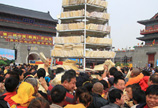
Wenzhou residents pitch in at the scene of the crash of high-speed trains on Saturday. They rushed to offer their help, but experts urge that rescue work be left to the professionals and highly trained volunteers. [Photo/ Xinhua] |
The 2-year-old might not have survived if police officer Shao Yerong and his team had not insisted on searching the carriage thoroughly. A crane was set to remove the carriage, where the little girl was trapped, from a viaduct. But Shao and his team intervened.
The "miracle girl" sobriquet became attached to Weiyi after Ministry of Railways spokesman Wang Yongping said at a Sunday news conference that her survival was a miracle.
Wang was asked why she was found alive after it was declared that there were no signs of life at the accident site. On Monday, the ministry denied making that declaration. A rescue official with the ministry did the same on Thursday.
However, the order to remove the carriage from the viaduct was made after life-detection equipment registered no signs of life.
Rescue experts said thorough efforts should have been made to search for passengers in the wreckage and to account for them one by one - especially since passengers had provided their identity information when they bought the train tickets.
"How could they give up hope in such a short time? Post-disaster rescue work is a race against time. What they have done did not follow the rule of rescue work," said Lu Zhonghong, the leader of Beijing-based Lvye rescue team. His team searched for victims of the Wenchuan earthquake in 2008 and the Yushu earthquake in 2010.
Rescue "prime time" is 72 hours. For those with traumatic injuries, more than 90 percent can survive if they're found within 24 hours. After 72 hours, the survival rate can drop below 20 percent, said Peng Bibo, medical team captain with China International Search & Rescue Team.
"Rescuers should have never underestimated the power of life," Lu said. "The strong instinct for survival often helps injured people to last for a long time.
"Human life is more precious than anything. Any intention of giving up lives to ensure the restoration of (train) traffic would have been ridiculous," he said.
'Just search carefully'
 |
|
A survivor is removed from the wreckage of a passenger train carriage on Saturday night in Zhejiang province. [Photo/Xinhua] |
Peng said that standard procedure in a rescue operation is to divide the area into several sections and assign them to different members.
The searchers are ordered to examine their areas carefully so they don't miss a single victim.
"The search should be carried out in every corner of the carriage, without relying entirely on life-detection instruments," Lu said.
The instruments that rescue teams often use employ audio, video, infrared and radar technologies. Their effectiveness varies with the surroundings, said Zhang Yong, team leader of Lantian rescue team in Beijing and an experienced quake rescuer.
"For example, radar detectors are vulnerable to Bluetooth signals from mobile phones. Their functions are greatly reduced in complex and noisy environments," Zhang said.
"They are not suitable for rescues in train crashes, due to the high magnetic field and shielding function of high-speed trains, so the information the machines provide may have deviations. When there are signs of life, machines may fail to find them."
According to Lvye team's Lu, rescuers largely use the equipment in earthquake rescues to probe for victims' fragile heartbeats, for they cannot see the people beneath the rubble.
"But in train crashes, it is not that difficult to find the people, because they just stay in the wreckage," he said.
"What rescue staff have to do is just to search carefully, and find everyone in the carriages, whether they are alive or not."
Even for the dead, Lu said, rescuers need to show respect and try their best to recover the bodies and belongings for the sake of the victims' loved ones.
Zhang said that from his experience, the best way to find passengers in an accident like Saturday's train crash is to set aside the equipment and "search manually in the narrow space" until everyone is accounted for. The bullet train "real-name registration system" should make that easy, he said.
Profit vs. people?
Medical experts questioned the professionalism of rescuers.
"The people who directly joined the rescue work are firefighters, railway track maintenance workers, police, soldiers and crowds near the accident spot. We cannot deny their rescue enthusiasm, but still we need to admit that they are all not professional rescue staff," said Zhang Mo, a doctor and disaster rescue expert from No 2 Hospital affiliated to Zhejiang University Medical School.
For example, he said, a wrong move when dealing with people with fractured bones or heart disease may easily worsen their condition or threaten their lives.
"The rescue process must follow a scientific order," he said. "Or else, the more people at the spot, the more chaos is raised - without professional training, instead of helping, they may cause more trouble indeed."
Some criticism went further. Wang Zechu, counsel to the Guangdong government, criticized the Ministry of Railways for not making saving lives the priority.
"After the accident happened, President Hu and Premier Wen urged involved departments to put lifesaving in the first place," Wang said. "However, as we see through the rescue process, the top goal for the Ministry of Railways seems to be resuming use of the track.
"In this case, the idea of market economy has invaded the social morality. Many believe that everything needs to be fast and profitable. But a government ministry should not adopt this idea," he said. "Profits should not be the priority."
The ministry rescue official in Wenzhou who spoke Thursday was not identified, but he was quoted on Xinhuanet: "There was no one saying to stop rescue work on the spot. We never stopped searching. We did not rely only on the life-detection equipment, since it's very difficult for the equipment to go through the carriage."
He also said that rescuers had searched every carriage. "That's why we found the little girl after the equipment showed no signs of life," he said.
|
 Xiang Weiyi receives treatment at a hospital in Wenzhou, Zhejiang province, July 25, 2011. [Photo/Xinhua] |
Weiyi improving
A Wenzhou newspaper has reported that Xiang Weiyi, who is 2 years 8 months old, started taking liquid food Wednesday. The hospital said the "miracle girl" won't lose her injured leg, and her relatives are delighted with improvements in her condition.
Weiyi's parents were Xiang Yu'an, 31, and Shi Lihong, 29. The family was from Wenzhou.


Copyright 1995 - . All rights reserved. The content (including but not limited to text, photo, multimedia information, etc) published in this site belongs to China Daily Information Co (CDIC). Without written authorization from CDIC, such content shall not be republished or used in any form. Note: Browsers with 1024*768 or higher resolution are suggested for this site.
License for publishing multimedia online 0108263 Registration Number: 130349