Offers becoming more varied as growing number of professionals from overseas seek employment in China, reports Wang Yan in Beijing.
Spring marks the high season for recruitment, when college students rush to job fairs before graduation in June. Stephen Baron, 25, was part of the throng.
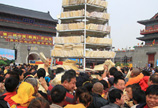
 More than 130 employers, offering 1,600 vacancies, set up stands at a job fair for foreigners in Beijing in April. A growing number of foreigners are seeking career opportunities in China. Provided to China Daily |
The difference is that the fair he went to was especially for foreigners.
Baron came to China from England in September 2009. He is studying Chinese at Tsinghua University in Beijing, and expects to complete the program in July. He graduated with a master's degree in international business in 2010 from the University of Nottingham Ningbo, China.
Shuttling among the employers' booths at a one-day April job fair in Beijing, Baron said he is equally open to jobs in any suitable field, although his primary choice is in management consultancy.
He came to the right place at the right time, at least in Xia Bing's opinion. Xia is director of the Information Research Center of International Talent at the State Administration of Foreign Experts Affairs (SAFEA), sponsors of the job fair.
"The job offers are becoming ever more varied," Xia said. "In our first job fair a few years ago, all offers were for teaching positions that only focused on language skills or the cultural background of the applicants. It didn't change much even after the third fair, when about 95 percent of the openings were for teaching positions. Now teaching positions make up only half of the offers."

Those positions, he said, include jobs in the media, information technology, manufacturing, finance and medicine.
SAFEA started holding job fairs for foreigners in January 2005. Only 17 employers and 25 foreign job hunters showed up. "In contrast, we saw about 1,200 to 1,500 job hunters coming to the job fair this year," Xia said.
His office said 460,000 foreign experts were working in China last year, up from 440,000 in 2008, and the SAFEA job fair is the only one in the country that targets foreigners. The April fair was the eighth in Beijing and the 11th nationwide, and more than 130 employers set up stands, looking to fill about 1,600 job vacancies.
The hirers came from Beijing, Tianjin, Hebei, Shanxi, Liaoning, Heilongjiang, Anhui, Fujian, Shandong, Guangdong, Jiangsu and other cities and provinces. Among them were representatives of the Beijing Economic and Technology Development Zone, Shougang Group, China Gezhouba (Group) Corp and China Agricultural University.
Higher skill level
Based on his observations at the job fair, Xia said, "Domestic companies have developed to the level where they have a solid need for foreign experts in terms of professional knowledge and skills." In the past, he said, some companies hired laowai (slang for "foreigner") for show.
 A young man discusses opportunities at the job fair sponsored by the State Administration of Foreign Experts Affairs in April. Provided to China Daily |
Late last year, domestic media covered a thriving trend known as bairen chong menmian, "white guy window dressing": Job agencies offer white- and dark-skinned men and women from Europe, North America, Australia and Africa to Chinese business owners, who hire them to pose as employees or partners at important meetings with dignitaries or potential investors.
According to previous reports, companies have been using the ethically questionable tactic for some time to boost credibility or present an image of being internationally connected.
The employers coming to the job fair, Xia said, were definitely looking for talent beyond appearance.
He named the Gezhouba Group, a hydroelectric construction company, as an example. "It is their first time here to hire foreign experts. In the past they had no such needs. Now, with fast development, they are looking for management, marketing and technical talents.
"During our first three sessions a few years ago," Xia said, "the job hunters were mainly college graduates. Now, about half have completed grad school, and 8 percent have a PhD."
More than language
Jeff Tennenbaum and Katarina Posa were among the hirers. The company they work for, The Language Key, is a training center based in Hong Kong that provides business English and other training to company executives and government officials.
Just coming back from Shanghai's job fair and heading to Guangzhou's, Posa said the team has been busy searching for talent.
"This is our fourth time attending the job fair. The Shanghai one exceeded our expectations. We interviewed 80 to 100 candidates in one day, and we are calling probably 15 to 20 for interviews. We are very happy with the result." Posa is the company's recruitment and special projects manager.
Echoing Xia, Posa said the company is looking, not for teachers, but for trainers with a professional business background.
"In our opinion, a teacher is only about an English teaching position. It is somebody who teaches the English language. For us, the trainers are professionals, which means we not only teach the language, but also professional skills, like negotiation, presentation, public speaking, leadership skills and cross-cultural communication. Therefore, our trainers should have a business background or a degree related to the business area."
Posa said one of the things they look for in their professionals is China or Asia experience. "It's really easier if the trainers understand the Chinese way of thinking."
Tennenbaum, chief financial officer and VP for corporate development for the company, said more people are coming from overseas in search of jobs.
"We see a greater number of people coming to China for business experiences. Especially after the financial crisis, many are going abroad for job opportunities and to broaden their horizons, to get some China and Asia experience," he said.
Tennenbaum said his company delivers training in several languages. The biggest demand is for English, but the company is hiring trainers with various language and cultural backgrounds.
'I want to learn'
Numbers from SAFEA's research center show that job seekers attending the job fairs increased from 450 in 2005, the first year, to 2,700 in 2010. The biggest one-year increase occurred in 2008-2009, jumping from 1,500 to 2,200.
The total for 11 of the job fairs is 8,500 job seekers. Their work experience was varied: 37 percent had 10 years or more, 29 percent had four to 10 years, 31 percent had one to three years.
Baron was in the remaining 3 percent, with no full-time working experience after graduation. Yet he has set his mind to "get a job in China for a long time before going back to England at some point".
"As someone who wants to, you know, progress a career within the business field, it's vital that you have a very solid understanding of Chinese businesses, Chinese customs and the Chinese culture. I really just want to learn as much as I can, to help me sort of develop my future career," he said.
"From a business standpoint, it's a particularly exciting time for China. The opportunities for development and, really, for developing a career, are very strong here. Within the next 20 years, maybe even a shorter time, China is going to have the strongest economy in the world."
Among his expectations from this China experience, similar to many other foreign job seekers interviewed by China Daily, is to improve his Chinese language skills.
Hired yet?
Xia said the hiring rate for this year's job fairs, in Beijing, Shanghai and Guangzhou, will not be known until June or July. "Our previous years' surveys on the hiring rate show 80 percent of the employers had found satisfactory talent," he said.
How successful was Baron's job hunt? "OK," he said. He has received emails from several potential employers, and on Wednesday he went to an interview with Asian Metal, a research and consulting company in the metals industry, for a consultancy position.
Baron said he was not sure whether a job offer would come out of it, but that he expects to start a job - some job - in July or August.


Copyright 1995 - . All rights reserved. The content (including but not limited to text, photo, multimedia information, etc) published in this site belongs to China Daily Information Co (CDIC). Without written authorization from CDIC, such content shall not be republished or used in any form. Note: Browsers with 1024*768 or higher resolution are suggested for this site.
License for publishing multimedia online 0108263 Registration Number: 130349