|
|||
 |
|||
|
|||
|
|||
|
|||
|
|
||||||||||||||||||
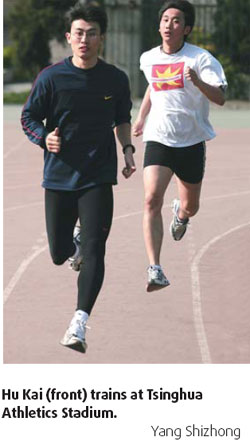
Brave new world for athletesBy Matt Hodges and Cui Xiaohuo (China Daily)Updated: 2007-06-22 10:33 Beijing's Tsinghua University, which is now training China's fastest man in 100m sprinter Hu Kai, offers its student athletes hope of a better tomorrow when the glory days of their sporting success has faded. Instead of evening mindset education sessions and a strict diet of training that may never pay off, they get a well-rounded education that probably will. In contrast, the State-run sports system has been criticized for leaving its athletes unskilled and jobless after raising them from an early age.
Tsinghua, which is closing the gap with the US college sports model, has attracted a raft of former national head coaches and is gaining widespread currency in China, even among the established order. "Until recently, there has never been another model to replace the State," said Wei Jizhong, a senior advisor for the Beijing Olympic Games organizing committee, or BOCOG. "But the Tsinghua model, as a beginning and as an alternative, is no ordinary model. It has huge vitality." Two years ago, the tension between the two systems was so strong that athletes from universities like Tsinghua could not advance to national teams, which only accepted applicants from State-run provincial sports schools. This spurred a wave of defections from Tsinghua and a lawsuit in 2005 against the national sports administration from former diving head coach Yu Fen, who was angered at seeing her most talented athletes get sucked back into the system. A court in Beijing ruled in her favor, allowing athletes to both study at college and join in national competitions representing their provincial teams. Famous for its diving and shooting teams, Tsinghua and its affiliated schools have already produced Asian Games shooting gold-medalist Liu Tianyou, 1m springboard world champion He Zi, 17, and a handful of new faces who hope to make a splash at next year's Beijing Games. If Hu Kai manages to clock 10.21 seconds in an Olympic qualifier before June 15 next year he will become the first Tsinghua athlete to compete at the prestigious 100m in the Olympics, something that will give the university model even more credibility at home. He also has a shot at the 200m, and the 4x100m relay if China qualifies. But if he fails to make the grade, he will have other options. Hu, a graduate student who is studying business management, already has an alternative career mapped out in the corporate world. Local media have recently jumped on the cases of former sportsmen and women whom China's state-controlled training system has not provided for, like former marathon runner Ai Dongmei. Ai hit a wall after her career ended, finally threatening to sell her medals after her coach reneged on his promise to pay her wages and bonuses. National weightlifting champion Zou Chunlan wound up working in a bathhouse before media pressure saw the government help her start a laundry shop. The unlucky ones can end up like 15-year-old Wang Yan, who broke her neck on the uneven bars at the National Games on June 10 and was left wondering who would take care of her. "Why do you think these past athletes have become scrubbers in shower houses or are selling their medals?" asked Li Qing, Tsinghua's short-distance running coach. "They are calling for people's awareness of the tragedy of the old system." Professional soccer coach Jin Zhiyang said their cases were just the tip of the iceberg, adding that change was inevitable. "The State model served China well when the country needed it, but I think the sports and education model will become dominant in the future." Diving coach Yu, who left the national team after the 1996 Atlanta Games, believes the new system will take root after the Beijing Games when China relaxes control of its athletes. "Now is like the darkest moment before dawn," she told China Daily last month. "But what was supposed to happen has already happened. The issue now is not whether the Tsinghua model will become dominant, but how." "The State model is single-aimed and purely result-driven," she said. "It makes both athletes and coaches feel uncomfortable. At Tsinghua, training athletes in this way, I feel at peace." She also said Tsinghua was facing problems of its own relating to fair play, registration and management. "New problems may emerge," she added. Sprinter Hu described Tsinghua as a national pioneer with much potential but said it was "confined by certain realities", like limited training facilities and a mediocre diet at the school canteen. "We still need help from the national training bureau with our training before big events," he said. Tsinghua runs a series of year-round Ma Yuehan Cup competitions, named after the man credited with founding its sports philosophy. It is also affiliated with schools across the country to scout and foster emerging talent of all ages. Ma, a chemistry teacher who joined the college in 1914, established its first stadium five years later. He campaigned about the virtuous nature of sports and would fail students who underperformed in the swimming pool or at fencing. He also coached China's track and field team on its debut at the 1936 Berlin Games. Now his legacy could be heading for a new high as China mulls full integration with the university model. "As far as I am concerned, the two systems will find a way to co-exist, because a school cannot do everything by itself," said BOCOG advisor Wei. |